Showing posts with label religion and government. Show all posts

Wednesday, May 27, 2015

"But the problem with thinking of Mars as a fallback planet (besides the lack of oxygen and air pressure and food and liquid water) is that it overlooks the obvious."

"Wherever we go, we�ll take ourselves with us. Either we�re capable of dealing with the challenges posed by our own intelligence or we�re not. Perhaps the reason we haven�t met any alien beings is that those which survive aren�t the type to go zipping around the galaxy. Maybe they�ve stayed quietly at home, tending their own gardens."

From "Project Exodus/What�s behind the dream of colonizing Mars?" by Elizabeth Kolbert in The New Yorker (which I believe is available even to nonsubscribers).

I'm reading that because I read The New Yorker, but by coincidence, I'd just been rereading old Dan Quayle quotes. (Because yesterday, it became necessary to remind you: "What a waste it is to lose one's mind, or not to have a mind is being very wasteful, how true that is.") And I loved this one:
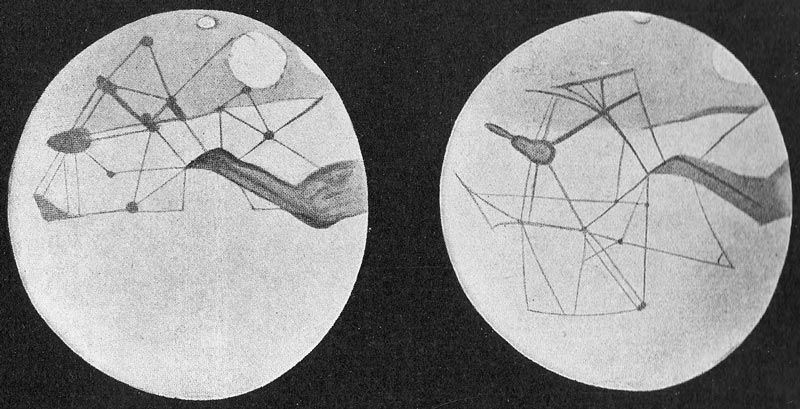
"Mars is essentially in the same orbit . . . Mars is somewhat the same distance from the Sun, which is very important. We have seen pictures where there are canals, we believe, and water. If there is water, that means there is oxygen. If oxygen, that means we can breathe."
Remember the Mars canals?


Almost as entrancing at The Man in the Moon:



But to get back to the garden � and to The New Yorker � here's a March 2007 piece by Adam Gopnik titled "Voltaire's Garden":
Voltaire goes on to detail the hideous theatrics of the Inquisition: the yellow robes, the burnings and flogging set to Church music, the whole choreography of Christian cruelty. The point of �Candide� is that the rapes and disembowelments, the enslavement and the beatings are not part of some larger plan, not a fact of the fatality of life and the universe, but fiendish tortures thought up by fanatics....

By �garden� Voltaire meant... the better place we build by love. The force of that last great injunction, �We must cultivate our garden,� is that our responsibility is local, and concentrated on immediate action... The horror that Voltaire wanted crushed, cruelty in the name of God and civilization, was a specific and contingent thing... The villains are the villains: Jesuits and Inquisitors and English judges and Muslim clerics and fanatics of all kinds. If they went away, life would be much better. He knew that the flood would get your garden no matter what you did; but you could at least try to keep the priests and the policemen off the grass. It wasn�t enough, but it was something.

"Non-Muslims who work in the Middle East, are forced to wear 'respectable' clothing by their employers, or face disciplinary measures."

"The Arab Muslims say that this demand is quite acceptable; and that this is to ensure that people adhere to local traditions and customs of the host country. So, with this same philosophy, why can't Europeans set a similar standard for migrants?"

That is, by far, the most up-voted comment (out of 708 comments) at the NYT article titled "Muslim Frenchwomen Struggle With Discrimination as Bans on Veils Expand."

I want to say that the answer to that question is obvious: Because we have a strong belief in religious freedom and personal expression. But I can't say "we," because I'm not French. From the article:
Mainstream politicians... say they [support the ban] for the benefit of public order or in the name of la�cit�, the French term for the separation of church and state.... The concept of la�cit� was developed during the French Revolution, and was intended to limit the influence of the Roman Catholic Church in the government.
A little more detail on that:
The strict separation of church and state... has evolved into what some religious leaders see as a "form of political correctness that made bringing religion into public affairs a major taboo." Former President Sarkozy initially criticised this approach as a "negative la�cit�" and wanted to develop a "positive la�cit�" that recognizes the contribution of faith to French culture, history and society, allows for faith in the public discourse and for government subsidies for faith-based groups. Sarkozy saw France's main religions as positive contributions to French society...  Sarkozy later changed footing on the place of religion in French society, by publicly declaring the burqa "not welcome" in France in 2009 and favoring legislation to outlaw it....

Thursday, April 16, 2015

"The Yazidi woman watched as her name was drawn out of a hat."

"Then a man she had never met told her to go into the bathroom and clean herself. But she knew better. As a Yazidi woman captured by the Islamic State, she knew that a bath was often prelude to rape. So she swallowed some poison and hoped to die."

From "Islamic State�s �war crimes� against Yazidi women documented," in the Washington Post.

Also:
Islamic State makes no secret about its enslavement of Yazidi women. In October, the group boasted about the practice in its English-language magazine, Dabiq.

�After capture, the Yazidi women and children were then divided according to the Shariah amongst the fighters of the Islamic State who participated in the Sinjar operations,� the magazine said, arguing that unlike Christians and Jews, Yazidis, as polytheists, could be treated as property. �The enslaved Yazidi families are now sold by the Islamic State soldiers.�

Wednesday, April 1, 2015

Arkansas Governor Asa Hutchinson sent the RFRA bill back to the legislature to be amended to look just like the longstanding federal RFRA.

"This is a bill that in ordinary times would not be controversial. But these are not ordinary times," he said. He wants Arkansas to be known as "a place of tolerance."
�What is important from an Arkansas standpoint is one, we get the right balance,� he said, �and secondly, we make sure that we communicate we�re not going to be a state that fails to recognize the diversity of our workplace, our economy and our future.�...

Several businesses and tech companies, including the state�s largest employer, Walmart, as well as the Little Rock Chamber of Commerce, the Arkansas Municipal League and other civic groups have spoken out against the legislation.
Meanwhile, in Indiana, under time pressure from � of all things � basketball, the state legislature is working on amending the language in its RFRA.

Monday, March 30, 2015

Instead of picking on Indiana, why don't we figure out if we want RFRA laws or not?

Here's Jonathan Adler's explanation of "What will the Indiana religious freedom law really do?"
RFRA laws are common, as shown by this map. Whether or not such laws are good policy, they are about accommodating religious belief, not authorizing discrimination....

The Indiana RFRA is not identical to every other RFRA, but the textual differences are not particularly material....

Are there any scenarios in which a state-level RFRA might result in an individual business owner denying service to a same-sex couple? Perhaps. The most likely scenario would be something like a religious wedding planner refusing to help plan a wedding that violates his or her religious beliefs. But even if such laws eventually allow this sort of thing, it is a far cry from... a general license to discriminate against one�s neighbors....
Indiana has focused attention on RFRA laws, but it's stupid to focus on Indiana. These laws are all over the place. Understand them. Understand how they apply in many different scenarios and how they are limited by courts in their application. Understand that if we're going to relieve religious believers of the burdens of generally applicable laws, courts are going to have to avoid preferring one religion over another. You can't accommodate the religions you agree with or think are sweet and fuzzy and say no to the ones who seem mean or ugly. We need to figure that out. If, in the end, you think the Indiana RFRA is a bad idea, check that map and see if your state has RFRA (or a RFRA-like state constitutional provision) and push for repeal in your state. And get after Congress. Congress started it. Unless you're Hoosier, leave Indiana alone. Stop otherizing Indiana.

AND: I had to wonder What does Garrett Epps think about this? Because Garrett Epps wrote a whole book about how terrible it was for the U.S. Supreme Court to deny special exceptions to religious believers, especially in that case where Native Americans wanted the freedom to use peyote. As I predicted, Epps is otherizing Indiana.

Sunday, March 29, 2015

Why am I avoiding this Indiana RFRA story?

I've got to examine my own soul! I see it � e.g., here �  and I know I'm avoiding it. There is something to examine. Why is Indiana getting into so much trouble over a type of law that used to be extremely popular? I guess it has something to do with Hobby Lobby and something to do with all that wedding cake business. There was a time when religionists had the ascendancy, and their pleas for relief from the burdens of generally applicable laws fell on the empathetic ears of conservatives and liberals alike.


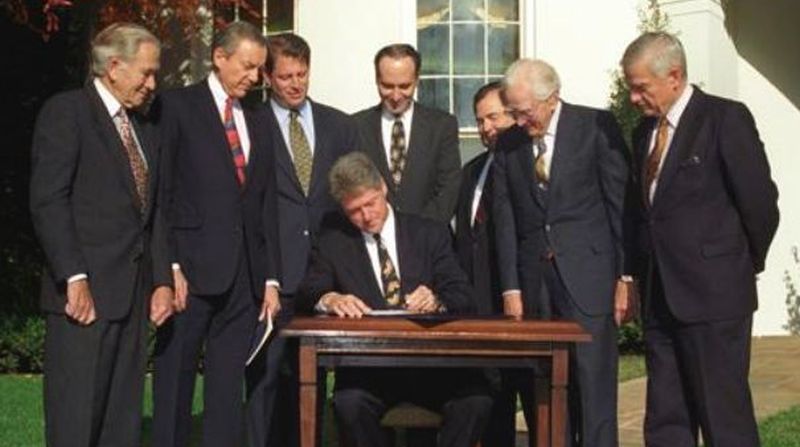
Look at how pleased Bill Clinton was to sign what was then perceived as important civil rights legislation.

The tables have turned. And now all the liberals are remembering how much they love Antonin Scalia. I mean, not really, but to be consistent, those who are denouncing hapless Governor Mike Pence should be extolling Scalia who ushered in the era of "Religious Freedom" legislation when he wrote:
We have never held that an individual's religious beliefs excuse him from compliance with an otherwise valid law prohibiting conduct that the State is free to regulate. On the contrary, the record of more than a century of our free exercise jurisprudence contradicts that proposition. As described succinctly by Justice Frankfurter in Minersville School Dist. Bd. of Educ. v. Gobitis, 310 U.S. 586, 594-595 (1940):
Conscientious scruples have not, in the course of the long struggle for religious toleration, relieved the individual from obedience to a general law not aimed at the promotion or restriction of religious beliefs. The mere possession of religious convictions which contradict the relevant concerns of a political society does not relieve the citizen from the discharge of political responsibilities.
(Footnote omitted.) We first had occasion to assert that principle in Reynolds v. United States, 98 U.S. 145 (1879), where we rejected the claim that criminal laws against polygamy could not be constitutionally applied to those whose religion commanded the practice. "Laws," we said, are made for the government of actions, and while they cannot interfere with mere religious belief and opinions, they may with practices. . . . Can a man excuse his practices to the contrary because of his religious belief? To permit this would be to make the professed doctrines of religious belief superior to the law of the land, and in effect to permit every citizen to become a law unto himself.

Subsequent decisions have consistently held that the right of free exercise does not relieve an individual of the obligation to comply with a valid and neutral law of general applicability on the ground that the law proscribes (or prescribes) conduct that his religion prescribes (or proscribes).
Okay, I'm working my way through this resistance to the topic. What I see is: A different group is activated now and everything looks different. What I feel is: Exquisitely distanced amusement.

Monday, March 23, 2015

"Why is it that prosecutors and prison administrators are among the first to understand that extreme religious liberty is dangerous and antithetical to core American values?"

"The answer is that many religiously motivated criminals appear in their courts and jail cells. Accordingly, they understand through experience that religious liberty sits atop a slippery slope that lands in the criminal code and a well of human suffering."

Writes lawprof Marci Hamilton in a tribute to the recently deceased. David Frohnmayer, former Oregon Attorney General, Dean of the University of Oregon Law School, and President of the University of Oregon.
Thankfully, Frohnmayer was the Attorney General of Oregon when Employment Div. v. Smith was litigated, because he had the knowledge and wisdom to argue that the drug counselors in that case � who had signed an agreement not to use illegal drugs or they would lose their jobs, and then used peyote as part of a religious ceremony � did not have a First Amendment free exercise right to break Oregon�s criminal laws or to receive unemployment compensation.

Unfairly maligned then and still by those who are so blinded by ideology they refuse to see the facts, history will lionize him for his role in Smith....
Smith is the reason why statutes like the Religious Freedom Restoration Act were passed. It said that there's no right under the Free Exercise Clause to exemptions from the neutral, generally applicable actions of government.

Thursday, March 19, 2015

"It is clear the act of the bar offended the majority religion in the country," said the judge, handing down a 2-year sentence.

The judge, U Ye Lwin, said that the 3 men had "denigrated Buddhism " in "violation of Myanmar�s religion act, which prohibits insulting, damaging or destroying religion."

The 3 men � a New Zealander and 2 Burmese � promoting some event at a bar, had put up a Facebook post with an image of Buddha wearing headphones. They'd quickly removed that image and even apologized:
"Our ignorance is embarrassing for us, and we will attempt to correct it by learning more about Myanmar�s religions, culture and history, characteristics that make this such a rich and unique society," the apology said.

Monday, March 16, 2015

"[I]f our educational system does not honestly and explicitly promote the central tenet of science�that nothing is sacred�then we encourage myth and prejudice to endure."

"We need to equip our children with tools to avoid the mistakes of the past while constructing a better, and more sustainable, world for themselves and future generations. We won�t do that by dodging inevitable and important questions about facts and faith. Instead of punting on those questions, we owe it to the next generation to plant the seeds of doubt."

Writes the scientist Lawrence M. Krauss in The New Yorker (in a piece that begins with a bit about Scott Walker's "I�m going to punt" answer on the question of evolution).

Thursday, March 5, 2015

"In one sentence I would say we are all children of a Heavenly Father who loves us equally."

"Oh, if the country could be like this... This bill is a model � not just of legislation, but more importantly of how to bridge the cultural rift tearing America apart."

"We have to find a way to live together. We just can't endlessly be litigating against each other. We can't endlessly be in culture wars. If you want to know why Utah got it right, it's because they actually called a truce in the culture war."