Said Justice Scalia, asked whether he's properly described as a conservative: "That depends on what you mean by conservative. I ought to be the pin-up of the criminal defense bar."
It's not the first time he's said that, and the idea of producing an image of Scalia as a pinup has already been thought of and has already been dismissed in "Why Lawyers Shouldn�t Use Photoshop."
Showing posts with label Scalia. Show all posts
Showing posts with label Scalia. Show all posts
Friday, May 15, 2015

Thursday, April 30, 2015
"Nary a 'no' vote in Louisiana House on resolution urging Ginsburg, Kagan recusal in gay marriage case."
Reports The Times-Picayune.
And why Ginsburg and Kagan in particular? What was the "public conduct suggestive of bias"? Just because you can predict in advance where their thinking on a legal issue will lead them doesn't mean they are any more biased and bereft of objectivity than anyone else on the Court. In fact, unpredictability is more suggestive of bias. Consistency in legal reasoning, case by case and in expressions about law, suggests that you are following the norms of constitutional interpretation.
ADDED: A commenter says that the "public conduct" is officiating at same-sex wedding ceremonies. I'm seeing this at The Hill:
Anyway, doing something doesn't mean you believe you have a right to do it, and it would be utterly unworkable to say judges who do something must recuse themselves in cases about whether there is a right to do something. Should a judge who's had an abortion have to recuse herself in abortion cases? Should a judge who has given a speech have to recuse himself in a free speech case?
ALSO: A separate question is: Let's assume that doing something does equal a statement that one has a right to do it. Is belief that a right exists bias? I can't see that. I think the argument is more that a decision about the law was arrived at too early. But that doesn't make sense. Judges are always thinking, writing, and speaking about the law, forming beliefs about the answers. There's nothing wrong with that. I know there's this idea that Supreme Court Justices shouldn't express their conclusions about cases that might later come before the Court. That's the stock answer to every other question at confirmation hearings, though the Senators doing the questioning don't seem to think there's anything wrong with repeatedly inviting nominees to tip their hand.
There was a famous instance of a recusal by a Justice who tipped his hand about a pending case. Back in '03, Justice Scalia dropped out of the case about whether "under God" in the Pledge of Allegiance violated the Establishment Clause:
Justices Ruth Bader Ginsburg and Elena Kagan "have each engaged in public conduct suggestive of bias," reads Louisiana House Concurrent Resolution 85, sponsored by state Rep. Valerie Hodges, R-Denham Springs. In engaging on the issue of same-sex marriage, the justices have "thus demonstrate(d) an inability to be objective," and should therefore withdraw from the Obergefell v. Hodges case, the resolution says.Embarrassing.
And why Ginsburg and Kagan in particular? What was the "public conduct suggestive of bias"? Just because you can predict in advance where their thinking on a legal issue will lead them doesn't mean they are any more biased and bereft of objectivity than anyone else on the Court. In fact, unpredictability is more suggestive of bias. Consistency in legal reasoning, case by case and in expressions about law, suggests that you are following the norms of constitutional interpretation.
ADDED: A commenter says that the "public conduct" is officiating at same-sex wedding ceremonies. I'm seeing this at The Hill:
�Justices Ginsburg and Kagan, knowing full well that unique legal issues regarding the definition of marriage would soon come before them, deliberately officiated at so-called homosexual wedding ceremonies creating not merely the appearance of bias, but an actual and blatant conflict of interest,� [said Scott Lively, president of Abiding Truth Ministries].I don't see how participating in a wedding ceremony is a statement that you think there is a constitutional requirement that states must recognize same-sex marriage. Presumably, same-sex marriage was either already recognized in the place where Ginsburg/Kagan was performing the ceremony or it was a ceremony that wasn't recognized as creating a legal marriage. That probably shows they approve of same-sex marriage, though what Ginsburg did was perform a wedding for a former law clerk. Maybe she just treats all her former law clerks the same.
�In my personal view they have committed an unparalleled breach of judicial ethics by elevating the importance of their own favored political cause of gay rights above the integrity of the court and of our nation.�
Anyway, doing something doesn't mean you believe you have a right to do it, and it would be utterly unworkable to say judges who do something must recuse themselves in cases about whether there is a right to do something. Should a judge who's had an abortion have to recuse herself in abortion cases? Should a judge who has given a speech have to recuse himself in a free speech case?
ALSO: A separate question is: Let's assume that doing something does equal a statement that one has a right to do it. Is belief that a right exists bias? I can't see that. I think the argument is more that a decision about the law was arrived at too early. But that doesn't make sense. Judges are always thinking, writing, and speaking about the law, forming beliefs about the answers. There's nothing wrong with that. I know there's this idea that Supreme Court Justices shouldn't express their conclusions about cases that might later come before the Court. That's the stock answer to every other question at confirmation hearings, though the Senators doing the questioning don't seem to think there's anything wrong with repeatedly inviting nominees to tip their hand.
There was a famous instance of a recusal by a Justice who tipped his hand about a pending case. Back in '03, Justice Scalia dropped out of the case about whether "under God" in the Pledge of Allegiance violated the Establishment Clause:
According to press accounts, in his talk to the Knights of Columbus, Justice Scalia adverted to the lower court rulings in the Newdow dispute twice -- both in his prepared remarks and in response to a protestor in the audience.Was that recusal required or even advisable? I don't think so. And I'm suspicious. I think the recusal served the interests of conservatives. As it happened, the Supreme Court weaseled out, but if the Court's liberals had not figured out a way to avoid the merits � they used standing doctrine � they might have had to say that "under God" violated the Establishment Clause, and that would have been very useful to conservatives in the 2004 presidential election. It was well-remembered that in the 1988 election, George H.W. Bush had battered Michael Dukakis over the Pledge of Allegiance:
First, Scalia mentioned prior rulings by his own Court indicating that government could not favor any religious sect or religion over non-religion. He observed that such rulings were "contrary to our whole tradition, [and] to 'in God We Trust' on the coins," and said that these rulings had created inconsistencies that lent "some plausible support" to the lower court rulings in Newdow.
Second, when Scalia saw a protest sign in the crowd, he remarked: "The sign back there which says, 'Get religion out of government,' can be imposed on the whole country. . . . I have no problem with that philosophy being adopted democratically. If the gentleman holding the sign would persuade all of you of that, then we could eliminate 'under God' from the Pledge of Allegiance. That could be democratically done." Scalia thus arguably implied that the elimination of the "under God" phrase could not be accomplished by any Court -- even his own.
With President Reagan at his side in a raucous campaign rally here, Vice President Bush intensified his argument with Michael S. Dukakis today over the Pledge of Allegiance. He said he would have signed a bill that Mr. Dukakis vetoed in 1977 requiring teachers to lead their classes in the pledge.Newdow was a rich political opportunity, and I'm sure Scalia knew that. So one could say that his recusal was biased, since he would have voted on the side that would not have leveraged the conservative presidential candidate.
'What is it about the Pledge of Allegiance that upsets him so much?'' Mr. Bush said of Mr. Dukakis, as an enthusiastic crowd roared its agreement. ''It is very hard for me to imagine that the Founding Fathers - Samuel Adams and John Hancock and John Adams -would have objected to teachers leading students in the Pledge of Allegiance to the flag of the United States.''
Tuesday, April 28, 2015
"It was rather refreshing, actually."
Said Justice Scalia after a protester interrupted the same-sex marriage oral arguments with some "burn in hell" anti-gay yelling. I was listening to the oral argument as I was walking to class, and despite being out in public, I was brought to tears. We had just heard some careful argument with decently thoughtful questions from the Justices, and it was just so brutal and crude to shout about hell for homosexuals. And then Justice Scalia said "It was rather refreshing, actually." And I did laugh a little. Because... what did he mean? I think he meant, you know, we've all got to be so sober and appropriately legalistic all the time, and here was a person just shouting out how he really felt. It's refreshing. I don't think Justice Scalia meant: You know, that's how I feel too. I think these gay people are just horribly deluded, they're trying to delude others, and a lot of people are getting sucked into the pit of hell. No... I don't think that. Do you?
Thursday, April 16, 2015
"When I began as a young lawyer in the 1960s, text was an interesting jumping-off point."
"It was sometimes even read from beginning to end. But it was rarely dispositive�. One of the great triumphs of Justice Scalia�s work on the Court over the years � with help from a number of the other justices � was to remind us that text does play an important role, and that we should be spending more time with the text."
Said NYU lawprof Burt Neuborne, talking about his new book, "Madison's Music: On Reading the First Amendment." Alongside him was Justice Sonia Sotomayor, whom he thanked for "her human voice." Is that a compliment? Is this a compliment: "It�s a fun book for someone who's not immersed in the law"? That's what she said about his book.
I got to that NYU page via email that promotes NYU School of Law things to the school's graduates (which include me). I hesitated to link to it, however, because I'm ashamed of the inaccuracy of this sentence:
Click for more �
Said NYU lawprof Burt Neuborne, talking about his new book, "Madison's Music: On Reading the First Amendment." Alongside him was Justice Sonia Sotomayor, whom he thanked for "her human voice." Is that a compliment? Is this a compliment: "It�s a fun book for someone who's not immersed in the law"? That's what she said about his book.
I got to that NYU page via email that promotes NYU School of Law things to the school's graduates (which include me). I hesitated to link to it, however, because I'm ashamed of the inaccuracy of this sentence:
Click for more �
Tuesday, March 31, 2015
"It would be strange indeed to give a clause that makes federal law supreme a reading that limits Congress�s power to enforce that law..."
"... by imposing mandatory private enforcement � a limitation unheard � of with regard to state legislatures," wrote Justice Scalia in an opinion called Armstrong v. Exceptional Child Center, issued this morning.
ADDED: In the comments, Smilin' Jack says: "WTF? Have they run out of those Easter-Bunny-Display-in-National-Park cases? At least those were funny."
Yes, let's get back to talking about cake. The important thing in America right now is cake. Why are we all hepped up to talk about RFRA (which had previously bored the bejeezus out of everyone)? Cake.
To say that the Supremacy Clause does not confer a right of action is not to diminish the significant role that courts play in assuring the supremacy of federal law. For once a case or controversy properly comes before a court, judges are bound by federal law....The dissenting opinion is by Justice Sotomayor, who is joined by Justices Kennedy, Ginsburg, and Kagan. The statute the 2 sides are interpreting is the Medicaid Act.
The dissent agrees with us that the Supremacy Clause does not provide an implied right of action, and that Congress may displace the equitable relief that is traditionally available to enforce federal law. It disagrees only with our conclusion that such displacement has occurred here.
ADDED: In the comments, Smilin' Jack says: "WTF? Have they run out of those Easter-Bunny-Display-in-National-Park cases? At least those were funny."
Yes, let's get back to talking about cake. The important thing in America right now is cake. Why are we all hepped up to talk about RFRA (which had previously bored the bejeezus out of everyone)? Cake.
Sunday, March 29, 2015
Why am I avoiding this Indiana RFRA story?
I've got to examine my own soul! I see it � e.g., here � and I know I'm avoiding it. There is something to examine. Why is Indiana getting into so much trouble over a type of law that used to be extremely popular? I guess it has something to do with Hobby Lobby and something to do with all that wedding cake business. There was a time when religionists had the ascendancy, and their pleas for relief from the burdens of generally applicable laws fell on the empathetic ears of conservatives and liberals alike.

Look at how pleased Bill Clinton was to sign what was then perceived as important civil rights legislation.
The tables have turned. And now all the liberals are remembering how much they love Antonin Scalia. I mean, not really, but to be consistent, those who are denouncing hapless Governor Mike Pence should be extolling Scalia who ushered in the era of "Religious Freedom" legislation when he wrote:
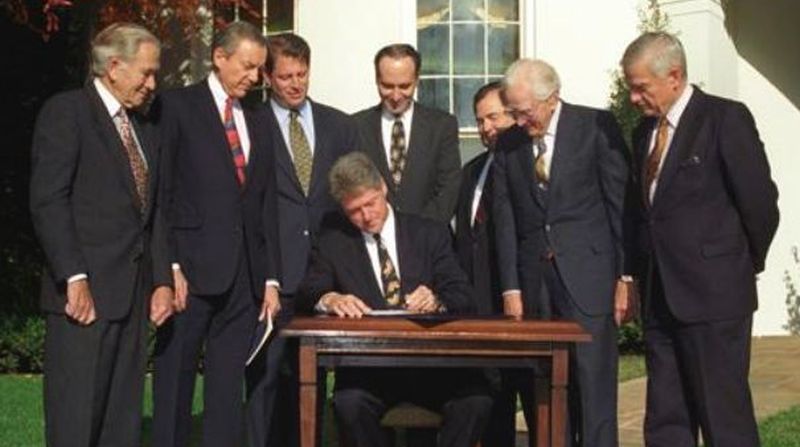
Look at how pleased Bill Clinton was to sign what was then perceived as important civil rights legislation.
The tables have turned. And now all the liberals are remembering how much they love Antonin Scalia. I mean, not really, but to be consistent, those who are denouncing hapless Governor Mike Pence should be extolling Scalia who ushered in the era of "Religious Freedom" legislation when he wrote:
We have never held that an individual's religious beliefs excuse him from compliance with an otherwise valid law prohibiting conduct that the State is free to regulate. On the contrary, the record of more than a century of our free exercise jurisprudence contradicts that proposition. As described succinctly by Justice Frankfurter in Minersville School Dist. Bd. of Educ. v. Gobitis, 310 U.S. 586, 594-595 (1940):Okay, I'm working my way through this resistance to the topic. What I see is: A different group is activated now and everything looks different. What I feel is: Exquisitely distanced amusement.Conscientious scruples have not, in the course of the long struggle for religious toleration, relieved the individual from obedience to a general law not aimed at the promotion or restriction of religious beliefs. The mere possession of religious convictions which contradict the relevant concerns of a political society does not relieve the citizen from the discharge of political responsibilities.(Footnote omitted.) We first had occasion to assert that principle in Reynolds v. United States, 98 U.S. 145 (1879), where we rejected the claim that criminal laws against polygamy could not be constitutionally applied to those whose religion commanded the practice. "Laws," we said, are made for the government of actions, and while they cannot interfere with mere religious belief and opinions, they may with practices. . . . Can a man excuse his practices to the contrary because of his religious belief? To permit this would be to make the professed doctrines of religious belief superior to the law of the land, and in effect to permit every citizen to become a law unto himself.
Subsequent decisions have consistently held that the right of free exercise does not relieve an individual of the obligation to comply with a valid and neutral law of general applicability on the ground that the law proscribes (or prescribes) conduct that his religion prescribes (or proscribes).
Wednesday, March 25, 2015
"It is easy to read the Supreme Court�s 5-to-4 decision in Alabama Legislative Black Caucus v. Alabama and Alabama Democratic Conference v. Alabama as a mostly inconsequential case..."
"... giving a small, and perhaps only temporary, victory for minority voters in a dispute over the redrawing of Alabama�s legislative districts after the 2010 census," writes Richard Hasen at SCOTUSblog.
Indeed, although the Supreme Court sent this �racial gerrymandering� case back for a wide and broad rehearing before a three-judge court, Alabama will be free to junk its plan and start over with one that may achieve the same political ends and keep it out of legal trouble. But Justice Antonin Scalia in his dissent sees the majority as issuing �a sweeping holding that will have profound implications for the constitutional ideal of one person, one vote, for the future of the Voting Rights Act of 1965, and for the primacy of the State in managing its own elections.� Time will tell if Justice Scalia�s warning against the implications of what he termed a �fantastical� majority opinion is more than typical Scalian hyperbole....ADDED: Here's the PDF of the opinion, which I can't read just yet.
Did Anthony Kennedy just reveal the outcome in King v. Burwell?
That's the pending case about whether there can be subsidies on the health insurance exchanges set up in the states by the federal government. On Monday, Justice Kennedy, testifying before a House committee on the court�s budget, said:
When this problem came up at oral argument, Justice Scalia said something that � as I explained here � some people thought was amusingly out of touch:
This Congress can't (or won't) fix it, so that was supposed to be a reason why the Supreme Court should fix the statute for them. In Monday's testimony, Anthony Kennedy called that "a wrong proposition." It's not the Court's role to perceive or predict gridlock. The Court must "assume" a "fully functioning" Congress. That is, the Court's approach to statutory interpretation � its idea of where the judicial role ends and when a problem with a statute needs a legislative solution � remains the same. The dysfunction of Congress doesn't change the function of the judicial branch, and Congress's inability to rewrite statutes does not give rise to an otherwise nonexistent judicial power to rewrite statutes.
Justice Kennedy is standing tough on separation of powers. Get ready!
Now, Kennedy could still find a way to use his idea of proper interpretation and still reach the result the government wants, and the difficulty of a congressional fix could affect the decision even if that's a dirty little secret not fit to mention in the written opinion. And, of course, as in the last Obamacare case, the 5th vote for the government could come from Chief Justice John Roberts.
So to answer the question in the post title: It's impossible to give a yes. But Kennedy revealed something that weighs against victory for the government.
It is not novel or new for justices to be concerned that they are making so many decisions that affect a democracy. And we think a responsible, efficient, responsive legislative and executive branch in the political system will alleviate some of that pressure. We routinely decide cases involving federal statutes, and we say, �Well, if this is wrong, the Congress will fix it.� But then we hear that Congress can�t pass the bill one way or the other, that there�s gridlock. And some people say, �Well that should affect the way we interpret the statutes.� That seems to me a wrong proposition. We have to assume that we have three fully functioning branches of the government, that are committed to proceed in good faith and with good will toward one another to resolve the problems of this republic.That is, Justice Kennedy clearly and soundly rejected the argument that the inability of Congress to fix a problem should not keep the Court from deciding that there is a problem with a statute that it is the role of Congress, not the courts, to fix.
When this problem came up at oral argument, Justice Scalia said something that � as I explained here � some people thought was amusingly out of touch:
What about Congress? You really think Congress is just going to sit there while all of these disastrous consequences ensue? I mean, how often have we come out with a decision such as the �� you know, the bankruptcy court decision? Congress adjusts, enacts a statute that takes care of the problem. It happens all the time. Why is that not going to happen here?The Solicitor General drew a laugh with the response "Well, this Congress?"
This Congress can't (or won't) fix it, so that was supposed to be a reason why the Supreme Court should fix the statute for them. In Monday's testimony, Anthony Kennedy called that "a wrong proposition." It's not the Court's role to perceive or predict gridlock. The Court must "assume" a "fully functioning" Congress. That is, the Court's approach to statutory interpretation � its idea of where the judicial role ends and when a problem with a statute needs a legislative solution � remains the same. The dysfunction of Congress doesn't change the function of the judicial branch, and Congress's inability to rewrite statutes does not give rise to an otherwise nonexistent judicial power to rewrite statutes.
Justice Kennedy is standing tough on separation of powers. Get ready!
Now, Kennedy could still find a way to use his idea of proper interpretation and still reach the result the government wants, and the difficulty of a congressional fix could affect the decision even if that's a dirty little secret not fit to mention in the written opinion. And, of course, as in the last Obamacare case, the 5th vote for the government could come from Chief Justice John Roberts.
So to answer the question in the post title: It's impossible to give a yes. But Kennedy revealed something that weighs against victory for the government.
Wednesday, March 4, 2015
Reading the King v. Burwell transcript.
Here's the PDF of today's oral argument. I'm going to read it right now and give my immediate impressions.
1. Justice Alito topped Justice Kagan at page 11, lines 7-13. Kagan had just sprung her elaborate clerks-writing-memos hypothetical, and Alito said "Well... if I had those clerks, I had the same clerks and Amanda wrote the memo, and I received it and I said, This is a great memo, who wrote it? Would the answer be it was written by Will, because Amanda stepped into Will's shoes?" Kagan had to respond to the laughter in the courtroom: "He's good."
2. Justice Sotomayor stumbles at page 16, line 2, after raising a principle of statutory interpretation from last year's Bond case (the chemicals-on-the-doorknob case, where the Court read a federal statute not to criminalize a matter that lay within the traditional powers of the state). She'd just spoken for a page and a half, and the petitioners' lawyer Michael A. Carvin was beginning to explain that this principle had never been applied in the context of a condition on federal spending. Sotomayor interrupted to "Oh, we did it -- we said it last year." But she just meant to repeat her point about Bond, which wasn't about conditional spending.
Click for more �
1. Justice Alito topped Justice Kagan at page 11, lines 7-13. Kagan had just sprung her elaborate clerks-writing-memos hypothetical, and Alito said "Well... if I had those clerks, I had the same clerks and Amanda wrote the memo, and I received it and I said, This is a great memo, who wrote it? Would the answer be it was written by Will, because Amanda stepped into Will's shoes?" Kagan had to respond to the laughter in the courtroom: "He's good."
2. Justice Sotomayor stumbles at page 16, line 2, after raising a principle of statutory interpretation from last year's Bond case (the chemicals-on-the-doorknob case, where the Court read a federal statute not to criminalize a matter that lay within the traditional powers of the state). She'd just spoken for a page and a half, and the petitioners' lawyer Michael A. Carvin was beginning to explain that this principle had never been applied in the context of a condition on federal spending. Sotomayor interrupted to "Oh, we did it -- we said it last year." But she just meant to repeat her point about Bond, which wasn't about conditional spending.
Click for more �
SCOTUSblog reports from the oral argument in King v. Burwell.
By Eric Citron. Excerpt:
AND: SCOTUSblog has a second person, Tejinder Singh, also doing mid-argument reporting. Excerpt:
[Justice Kagan... offered (something like) the following example: Imagine I tell law clerk A to write a memo, and law clerk B to edit law clerk A�s memo, and then I tell law clerk C to write such memo if law clerk A is too busy. And imagine that happens � law clerk A is too busy, so law clerk C writes it. Should law clerk B edit it?... In response, petitioner�s counsel said that the context mattered, and it would depend on whether the Justice was indifferent between law clerk A and law clerk C writing the memo in the first instance. But that seemed to play into Justice Kagan�s hand, who made clear that this was her point � that in understanding this text, the context obviously mattered....ADDED: I need to see the whole transcript � context matters! � but if this accurately portrays Kennedy's overall analysis, I think the government will win. This idea is that the challengers' interpretation asks the Court to read the statute to do something that would have to be stricken down as unconstitutional, because it would coerce the states to set up the exchanges. Congress lacks the power to commandeer the states and may only offer the states a choice. If the incentive to make the choice Congress wants is too heavy-handed � as it was with the Medicaid expansion in the 2012 Obamacare case � the would-be incentive is viewed as coercion. So if the provision is unconstitutional under the challengers' interpretation, in Kennedy's view, he will have reason to agree with the government's interpretation (that is, he would follow the doctrine of constitutional avoidance).
[Justice Kennedy]... pointed out that, under petitioners� reading, the federal government would be all but forcing states to create their own exchanges.... not just [because otherwise] their citizens would be denied benefits... [but also because] state insurance systems will fail if the subsidy/mandate system created by the statute does not operate.... For Kennedy, that seemed to make this case an echo of the last healthcare decision, where the Court concluded that it was unconstitutional coercion for the federal government to condition all Medicaid benefits in the state on expanding Medicaid therein.... Justice Scalia attempted to respond on petitioners� behalf that such concerns do not enter if the statute is unambiguous, but Justice Kennedy reiterated his concern with adopting a reading that would create such a �serious unconstitutional problem.�
AND: SCOTUSblog has a second person, Tejinder Singh, also doing mid-argument reporting. Excerpt:
Justice Breyer [noted] that if the phrase �established by the state� is read to exclude exchanges created by HHS, then other provisions of the statute that also use that phrase would be rendered inoperative or nonsensical... The statute provides that insurance shall be made available on exchanges to �qualified individuals,� and further defines a �qualified individual� to mean, �with respect to an Exchange, an individual who� both wants to enroll in a qualified plan, and also �resides in the State that established the Exchange.� The government, as well as Justices Breyer and Kagan, argue that if the only way for a state to �establish� an exchange is to create it on its own, then there would be no �qualified individuals� in states that failed to do so, and therefore there would be nobody on the [HHS] exchanges (and, as Justice Kagan surmised, no product to sell on the exchanges).
Subscribe to:
Posts (Atom)