Showing posts with label law. Show all posts

Monday, June 1, 2015

"We granted certiorari to resolve a conflict in the lower courts over the appropriate mental state for threat prose�cutions under 18 U. S. C. �875(c)."

"Save two, every Circuit to have considered the issue�11 in total�has held that this provision demands proof only of general intent, which here requires no more than that a defendant knew he transmitted a communication, knew the words used in that communication, and understood the ordinary meaning of those words in the relevant context. The outliers are the Ninth and Tenth Circuits, which have concluded that proof of an intent to threaten was necessary for conviction. Adopting the minority position, Elonis urges us to hold that �875(c) and the First Amendment require proof of an intent to threaten. The Government in turn advocates a general-intent approach. Rather than resolve the conflict, the Court casts aside the approach used in nine Circuits and leaves nothing in its place. Lower courts are thus left to guess at the appropriate mental state for �875(c). All they know after to day�s decision is that a requirement of general intent will not do. But they can safely infer that a majority of this Court would not adopt an intent-to-threaten requirement, as the opinion carefully leaves open the possibility that recklessness may be enough."

Writes Justice Thomas, the sole dissenter in Elonis v. United States (PDF) one of this morning's new Supreme Court cases.
Click for more �

"Is sexual desire a human right?"

"And are women entitled to a little pink pill to help them feel it?"
Those questions are being raised in a campaign that is pressing the Food and Drug Administration to approve a pill aimed at restoring lost libido in women. The campaign, backed by the drug�s developer and some women�s groups, accuses the F.D.A. of gender bias for approving Viagra and 25 other drugs to help men have sex, but none for women....

The drug, flibanserin, has been rejected twice by the F.D.A. on the grounds that its very modest effectiveness was outweighed by side effects like sleepiness, dizziness and nausea....
I don't see how women are "entitled" to a drug in the general area of Viagra as some kind of gender equity proposition. The standard for approval of all drugs should be the same � some balance of effectiveness and unwanted effects. And obviously, there's a big difference between wanting to have sex and the capacity to physically carry out the act. Why is not wanting to have sex even regarded as a dysfunction? I want to want what I don't want. What the hell kind of problem is that? Or is it that my partner wants me to want what I don't want and I want to satisfy him? Drugging women so we'll be able to do what men want? How did that get turned into a women's rights issue? I guess you could say that it's for women to decide � don't take away our choice! � whether we want to want what he wants when we don't want it.
�Our usual patient is someone who is fearful of losing the relationship they have been in for years,� said Dr. Irwin Goldstein, director of sexual medicine at Alvarado Hospital in San Diego and a consultant to many drug companies. �It�s tragedy after tragedy after tragedy.�

One of his patients, Jodi Cole, 33, of Porter, Okla., said her lack of desire �tends to cloud my thoughts of everything related to my husband.� She said that �replacing the dread I have for intimacy with desire would be life-changing.�
Meanwhile, on college campuses, Cole's frame of mind � needing to have sex out of fear of losing the man � would be enough to brand her husband as a rapist if he proceeded to have sex with her knowing that's how she felt. And yet we're asked to think a drug that causes sleepiness, dizziness and nausea should be approved � in the name of women's rights � so she can blot out her lack of true consent.

This flibanserin is like those rape drugs frat boys are said to put in the unguarded drink. Oh, but if the woman chooses to take the drug? Well, isn't that like choosing to get drunk at the party? The man isn't supposed to exploit the opportunity of a drunken and seemingly willing sexual partner. Why is it okay to have sex with a woman who's taken the flibanserin?


Denny Hastert "was a bland, utterly conventional supporter of the status quo; his idea of reform was to squelch..."

"... anyone who disturbed Congress�s usual way of doing business," writes John Fund "How Did Denny Hastert Get Rich Enough to Pay Millions to an Accuser?"
I saw him become passionate only once, when he defended earmarks � the special projects such as Alaska�s �Bridge to Nowhere� that members dropped at the last minute into conference reports, deliberately leaving no time to debate or amend them....

The [Sunlight Foundation] found that Hastert had used a secret trust to join with others and invest in farm land near the proposed route of a new road called the Prairie Parkway. He then helped secure a $207 million earmark for the road. The land, approximately 138 acres, was bought for about $2.1 million in 2004 and later sold for almost $5 million, or a profit of 140 percent. Local land records and congressional disclosure forms never identified Hastert as the co-owner of any of the land in the trust. Hastert turned a $1.3 million investment (his portion of the land holdings) into a $1.8 million profit in less than two years. Hastert claimed at the time that the land deals had nothing to do with the federal earmark he had secured. �I owned land and I sold it, like millions of people do every day,� he told the Washington Post. Or, as George Washington Plunkitt, the former Tammany Hall leader in New York, once said of someone who made a killing in local land that later became part of a lucrative subway development: �He saw his opportunities and he took �em.� Plunkitt called such �opportunities� a form of �honest graft.�...
ADDED: But getting that money isn't the crime Hastert is charged with. Nor is conveying that money to a person who accused him of wrongdoing. Lawprof Noah Feldman describes the conduct the government cites in its charges (I've added some boldface):
First, [Hastert] made 15 withdrawals of $50,000 each from his own accounts. The withdrawals were not criminal, but they did trigger a federal law that requires a bank to report any transaction or series of transactions of more than $10,000. In April 2012, according to the indictment, bank officials questioned Hastert about the withdrawals.

Presumably, in those conversations or in conjunction with them, Hastert realized for the first time that he shouldn't be making withdrawals of more than $10,000 if he didn't want to trigger scrutiny. Beginning in July 2012, Hastert switched his withdrawals so that they were less than $10,000 each -- to a total of $952,000. That was a crime under the law that prohibits knowingly structuring transactions to avoid reporting. And it's a crime that seems easy to prove, given Hastert�s change in his withdrawal practices.

Unfortunately for Hastert, when the FBI and IRS questioned him about the structure of the transactions in December 2014, he lied to them, insisting that he �did not feel safe in the banking system.� When asked directly what he did with the money, he said, �Yeah, I kept the cash. ... That's what I'm doing.� The lie to federal officials was a crime, too.
All of that is easy to prove, but we might nevertheless wonder whether the choice to prosecute is really based on the alleged wrong that Hastert spent so much money to hush up. Feldman asks why the government keeping things hushed up too and observes that if the underlying accusation is false and Hastert "was being blackmailed unjustly, then the government's prosecution seems heartless to the point of being abusive." Feldman concludes: "we should know what happened or Hastert shouldn't be charged."

But that assumes that the crimes Hastert seems to have committed should go unprosecuted unless there's something else that that makes us want to convict him of something. I think what is abusive is to have crimes that we don't believe in enforcing that are sitting around only to be used on occasions when we have some other problem with a person!

Sunday, May 31, 2015

"The Senate opened a rare Sunday night session in a desperate attempt to extend a national security surveillance program... that was on the verge of expiring at midnight."

"Senator Harry Reid, Democrat of Nevada, criticizing Mr. McConnell on the Senate floor, said, 'The majority leader had five months' to fix the problem through committee work. 'Everyone saw this coming,' Mr. Reid, the Senate minority leader, said."
The session quickly became contentious when Senator Rand Paul, the other Kentucky Republican, whom Mr. McConnell has endorsed for president, fought for the right to speak. After being rebuked by Senator John McCain, Republican of Arizona, for not understanding the Senate rules, Mr. Paul railed against the surveillance program. �We should be upset, we should be marching in the streets,� he said.

Mr. Paul seemed determined to use his procedural weapon � the words �I object�...

Saturday, May 30, 2015

"Have We Learned Anything From the Columbia Rape Case?"

This is a longish NYT Magazine article by Emily Bazelon. Is there anything new here or is this more of a summary of a problem � a conflict � that those of us who've been following the story already know?

1. How Nungesser's parents felt at graduation: It was "devastating," they say, "especially... an exhibition at a university gallery...  that included Sulkowicz�s prints of a naked man with an obscenity and of a couple having sex, inked over a copy of a Times article about Nungesser." I'm a little confused by the word "prints." Prints like etchings or lithographs? Sulkowicz � in email (I think to Bazelon) � called the "prints" "cartoons."

2. Sulkowicz's email gives some insight into the kind of rhetoric she is purveying: "What are the functions of cartoons? Do they depict the people themselves (a feat which, if you�ve done enough reading on art theory, you will realize is impossible), or do they illustrate the stories that have circulated about a person?" Suddenly, I'm thinking about the Charlie Hebdo massacre and other incidents involving cartoons depicting Muhammad. Maybe those who get murderous over cartoons just haven't read enough art theory. And I'm put off by the assertion that if only people would read the right amount of a prescribed sort of material, we'd necessarily believe a particular sort of thing. It's saying: The only reason you don't already agree with me is that you're ignorant.

3.  And I don't even understand how those 2 sentences in Sulkowicz's email addressed the pain experienced by Nungesser's parents. Aside from the parenthetical, which is an assertion, the 2 sentences are 2 questions, but the first question sets up the second question, and the second question is an either/or question, within which the first option is negated by the assertion in the parenthetical. Therefore, Sulkowicz really is saying her cartoons "illustrate the stories that have circulated about a person." So her art work is an illustration added to a NYT story that gives graphic reality to the allegations that were made about Nungesser.

4. I wrote "gives graphic reality to" because I was straining to avoid the word that normally comes to mind: depict. Not having read enough art theory to realize that it is impossible to depict Nungesser himself, I thought the use of that word might make me look ignorant to those who have done the homework. But, for the record, "depict" means "To draw, figure, or represent in colours; to paint; also, in wider sense, to portray, delineate, figure anyhow." Anyhow! As in "The solar progress is depicted by the Hindoos, by a circle of intertwining serpents." R. J. Sulivan View of Nature II. xliv. 288  (1794). (Definition and quote via the unlinkable OED.)

5. Columbia University President Lee C. Bollinger avoided shaking Sulkowicz's hand at graduation and the university has taken the position that it wasn't actual shunning but the mattress getting in the way. Bazelon doesn't come out and call bullshit, but she links to the video so we can decide for ourselves.

6. Because we don't have the transcript of Columbia's disciplinary proceedings, "even the procedural disputes between Sulkowicz and Nungesser are lost in the land of she-said-he-said." Sulkowicz says she was asked "ignorant and insensitive questions." (That's Bazelon's paraphrase.) But we're not seeing the actual context. And Sulkowicz and Nungesser are saying different things about whether their friendly Facebook conversations were admitted as evidence. It's frustrating to have this matter become so public � through Sulkowicz's performance art � and then be deprived of the transcript, but Columbia has to protect student privacy and to encourage other students to feel secure that their privacy will be protected if they need to file a complaint or if they are accused.

7. Columbia is trying to improve its procedure: "Students are now permitted to bring a lawyer to their hearings, and if they can�t afford an attorney, the university will provide one. The university also hired new investigators and other staff members and gave training on how to hear cases to the administrators who serve as panelists."

8. Sulkowicz says "the system is broken because it is so much based on proof that a lot of rape survivors don�t have." And: "Even if you have physical evidence, you can prove that violence occurred but not that someone didn�t want the sex to be violent." Presumably, she wants to fix the system by avoiding the need to prove things that are too hard to prove. Here, that would be the mental element that accompanies the sexual act. But how can you possibly get rid of the need for that evidence?

9. Some people say, get rape cases out of university proceedings and into the criminal justice system. Bazelon's response to that is: "[I]n the eyes of the government, universities have this responsibility because of an important principle rooted in the federal law, Title IX: If a rape prevents a victim from taking full advantage of her education, then it is a civil rights violation as well as a crime." Quite aside from what statutory law requires, universities may properly see themselves as having a role in making the campus environment a safer and friendlier place. Bazelon refers to counseling, academic accommodations, assurances that alleged assailants won�t contact complainants, and education about prevention of sexual assaults.

10. Bazelon mentions early on that Nungesser is suing Columbia, but she doesn't connect that to other issues she discusses. She doesn't say that his lawsuit is based on Title IX (though, as you see in point #9, she says that Title IX causes universities to want to remain involved in providing remedies to victims). And she talks about Bollinger's avoidance of Sulkowicz at graduation (point #5, above) without saying that Bollinger is a named defendant in Nungesser's lawsuit.

Friday, May 29, 2015

"Using masculinities theory, the article examines last year�s hullabaloo about openly gay football player Michael Sam and his prospects for playing in the National Football League."

"I first explain masculinities theory, focusing on how masculinity is constructed and maintained. I then explore how masculinities theory applies in sport generally and in football in particular. The article visits the football locker room � a distinct enclave of masculinity � and shows how masculinities theory explains the locker room 'bonding.' Once we lay bare the implications of cultural assumptions about masculinity and about physically aggressive sports like football, we can more easily explain why an openly gay football player is a rarity. Knowing that even one openly gay player exists threatens to decimate the cultural icons we use our athletes to create."

An abstract for a law review article.

Thursday, May 28, 2015

Eugene Volokh thinks the Madison, Wisconsin school board is violating the First Amendment...

... with its new rule against "clothing with words, pictures or caricatures based on negative stereotypes of a specific gender, race, ethnicity, nationality, religion, sexual orientation or disability" and against "shirts, hats or other attire with Native American team names, logos or mascots that depict negative stereotypes."

"There is no way that she did not know what was going on, that women were being abused and accosted by her husband."

"She knew what was happening and just to ignore it. It was a political relationship and suited them both. The Clintons don't care what they do, who they run over to get to the top. It is all about political status."

Said Paula Jones, who was run over so long ago that many young voters have never heard of her.

"Did this have something to do with Monica Lewinsky?" a student asked last month when we read Clinton v. Jones. I wondered whether the Supreme Court's statement of the facts in that case came as a strange surprise to the young people in the class:
Those allegations principally describe events that are said to have occurred on the afternoon of May 8, 1991, during an official conference held at the Excelsior Hotel in Little Rock, Arkansas. The Governor delivered a speech at the conference; respondent--working as a state employee--staffed the registration desk. She alleges that Ferguson persuaded her to leave her desk and to visit the Governor in a business suite at the hotel, where he made "abhorrent" sexual advances that she vehemently rejected. She further claims that her superiors at work subsequently dealt with her in a hostile and rude manner, and changed her duties to punish her for rejecting those advances. Finally, she alleges that after petitioner was elected President, Ferguson defamed her by making a statement to a reporter that implied she had accepted petitioner's alleged overtures, and that various persons authorized to speak for the President publicly branded her a liar by denying that the incident had occurred.

Does this mean Obama's immigration plan will only be carried out if the next President wants to do it?

I'm trying to delve into the true import of this NYT article titled "Immigration Overhaul May Be in Limbo Until Late in Obama�s Term." The headline seems to inject some optimism into the scenario. Let's look closely:

1. There's a preliminary injunction in place preventing Obama from going forward with his plan, and the Justice Department has chosen not to go to the Supreme Court now. So the litigation continues on the merits in the 5th Circuit Court of Appeals, which will take some time. When it ends, whoever wins will seek Supreme Court review. That's going to take some time.

2.  How much time? The NYT says: "That legal battle may extend for a year or more, officials said, undermining any hope of putting the president�s plan into effect until right before the 2016 election." I take that to refer to the possibility that the Supreme Court (assuming it takes the case) would come out with a decision before it goes on its summer break, which would leave Obama with half a year to go forward with his plan.

3. Would Obama start up his program right on the eve of his successor's election? It's a political problem, but it's not just a political problem. Politically, it might help the Democratic candidate to have the program begun so that she (or he) can say you need me to continue it. Pressure could be put on the Republican to say whether he'd keep it going or not and what he'd do with the problem instead. Obama could choose whichever works better for the Democrat, when the time comes. At a late point in the campaign, he'll have the power to affect the factual context of the immigration issue.

4. But it's also a practical problem. It's a program that invites undocumented immigrants to "come out of the shadows." Who will want to do that in late 2016? If it won't work, because those who are eligible to come out lack confidence that the program will stay in place, then why do it? Well, the reasons discussed in point #3 might still hold. Begin the program for show. You've got a safe haven for people but the people are too afraid to use it. Look! Isn't that sad! Don't you want to vote for the candidate who will make it possible for people to use this wonderful plan Obama thought up? That's the political argument that could be built on the practical problem.

5. The political argument built on the practical problem only works if it turns out that voters in the swing states want the reform and approve of Presidents acting independently of Congress. But, as noted in point #3, Obama will make the decision close to the election, so he'll have up-to-date  information about how people feel � not only what they think about immigration but whether they're susceptible to the argument that it's important for Obama to end his presidency on a high note. His word is "HOPE." Wouldn't it be beautiful if he ended with this success that is the very essence of hope? Will that idea resonate in the summer and fall of 2016? He can decide when the time comes.

6. Points ##3, 4, and 5 all assume Obama will win in the Supreme Court. That's unlikely, I think. If he loses, however, he hands his party's candidate an excellent issue: those terrible conservatives on the  Supreme Court who are ruining everything.

Wednesday, May 27, 2015

"Nebraska on Wednesday became the first conservative state in more than 40 years to abolish the death penalty..."

"... with lawmakers defying their Republican governor, Pete Ricketts, a staunch supporter of capital punishment who had lobbied vigorously against banning it."

Nice going, Nebraska.

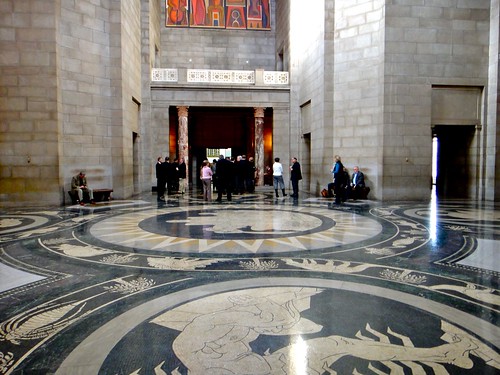
DSC01984

"Swiss authorities conducted an extraordinary early-morning operation here Wednesday to arrest several top soccer officials and extradite them to the United States on federal corruption charges."

"As leaders of FIFA, soccer�s global governing body, gathered for their annual meeting, more than a dozen plain-clothed Swiss law enforcement officials arrived unannounced at the Baur au Lac hotel, an elegant five-star property with views of the Alps and Lake Zurich. They went to the front desk to get room numbers and then proceeded upstairs."

What a scene!

ADDED: Shouldn't America leave soccer problems to the countries that call it football?

"Non-Muslims who work in the Middle East, are forced to wear 'respectable' clothing by their employers, or face disciplinary measures."

"The Arab Muslims say that this demand is quite acceptable; and that this is to ensure that people adhere to local traditions and customs of the host country. So, with this same philosophy, why can't Europeans set a similar standard for migrants?"

That is, by far, the most up-voted comment (out of 708 comments) at the NYT article titled "Muslim Frenchwomen Struggle With Discrimination as Bans on Veils Expand."

I want to say that the answer to that question is obvious: Because we have a strong belief in religious freedom and personal expression. But I can't say "we," because I'm not French. From the article:
Mainstream politicians... say they [support the ban] for the benefit of public order or in the name of la�cit�, the French term for the separation of church and state.... The concept of la�cit� was developed during the French Revolution, and was intended to limit the influence of the Roman Catholic Church in the government.
A little more detail on that:
The strict separation of church and state... has evolved into what some religious leaders see as a "form of political correctness that made bringing religion into public affairs a major taboo." Former President Sarkozy initially criticised this approach as a "negative la�cit�" and wanted to develop a "positive la�cit�" that recognizes the contribution of faith to French culture, history and society, allows for faith in the public discourse and for government subsidies for faith-based groups. Sarkozy saw France's main religions as positive contributions to French society...  Sarkozy later changed footing on the place of religion in French society, by publicly declaring the burqa "not welcome" in France in 2009 and favoring legislation to outlaw it....

Tuesday, May 26, 2015

"It is also alleged that she moved the paddle away from him as he was struggling to stay afloat..."

"... with water temperatures in the 40 degree range, and failed to render him assistance including timely calls for help."

Said the prosecutor in that Hudson River kayak case.

The Supreme Court will answer a key question about the meaning of "one person, one vote."

Legislative districts must have roughly equivalent populations. That's been Equal Protection law for a long time. But how do you count the population? Do you include all residents or just those who are eligible to vote � or are states free to use either count?
Almost all state and local governments draw districts based on total population. If people who were ineligible to vote were evenly distributed, the difference between counting all people or counting only eligible voters would not matter. But demographic patterns vary widely.

If the challengers succeed, the practical consequences would be enormous, Joseph R. Fishkin, a law professor at the University of Texas at Austin wrote in 2012 in The Yale Law Journal.

It would, he said, �shift power markedly at every level, away from cities and neighborhoods with many immigrants and many children and toward the older, whiter, more exclusively native-born areas in which a higher proportion of the total population consists of eligible voters.�
"One person, one vote" sounds like a reference to the voters, but that phrase comes from the court cases, not the Constitution itself. You could also think in terms of equality in the number of persons each representative represents. And if we're going to think in terms of voters, why would we look at the number of persons eligible to vote as opposed to the number of persons who actually vote? We know that voter turnout varies geographically.

"Four Words That Imperil Health Care Law Were All a Mistake, Writers Now Say."

A NYT article about the Obamacare case that's pending in the U.S. Supreme Court. A key word in that headline is "now." At this point � with so many states having decided not to set up their own exchanges � those who support Obamacare have a strong interest in saying that the discrepancy in the text is meaningless:
At the Finance Committee, which thrashed out its version of the bill in September and October 2009, senators initially assumed that all states would set up exchanges, so they added a section to the Internal Revenue Code to provide subsidies, in the form of tax credits, for insurance purchased through an exchange.

But senators and staff lawyers came to believe that some states � �five or 10 at the most� � would choose not to set up exchanges, said Christopher E. Condeluci, who was a staff lawyer for Republicans on the Finance Committee.

At that point, senators authorized a backup plan to allow the federal government to establish an exchange in any state that did not have its own, but they failed to include that language in the section of the tax code providing subsidies. �We failed to include a cross-reference to the federal exchange,� Mr. Condeluci said. �In my opinion, due to a drafting error, we overlooked it. It was an oversight. Congress, in my experience, always intended for the federal exchange to deliver subsidies.�

The words were written by professional drafters � skilled nonpartisan lawyers � from the office of the Senate legislative counsel, then James W. Fransen. It appears that the four words now being challenged were based on the initial premise and were carelessly left in place as the legislation evolved.
So... skilled, professional drafters... failing to check the cross-references. That's the story. As opposed to the idea that the loss of the subsidies was supposed to motivate the states to set up exchanges.

I think the main problem is that if there were a big incentive on offer, it needed to be clearly stated so the states would know what they were giving up if they failed it set up exchanges. But there's still the question whether the Court can remedy that unfairness. If it doesn't, Congress will need to step up.

Monday, May 25, 2015

The problem with "The Tolerant Jeweler Who Harbored an Impure Opinion of Same-Sex Marriage."

All Right, you've probably seen this Charles C.W. Cooke headline at The National Review for a story about a lesbian couple in Canada who ordered wedding rings and then wanted their money back when they found out the jeweler opposes same-sex marriage.
When the couple �found out what he really believed about same-sex marriage,� Dreher writes, they �balked, and demanded their money back � and the mob threatened the business if they didn�t yield.� Which is ultimately to say that White and Renouf sought to break their contract � not, you will note, because he was rude or because he failed to deliver on his promises, but because they made a window into his soul and they did not like what they saw � and then, when he objected, to subject him to bullying and to threats until he caved. Is that �tolerance�?
1. It's not breaking a contract to ask to be released from a deal. The very fact that Cooke added "sought" shows that "breaking" (like "breaching") is the wrong word. Parties to a contract can reach a new agreement, ending the deal. That doesn't break the contract. It rescinds the contract by mutual agreement.

2. Cooke leaves readers to think that the jeweler merely held an opinion � in his mind, in his soul � and people peered into that secret, personal space and took umbrage. But � click on the link in Cooke's article and get to the news story � the jeweler posted a sign in his store: "The sanctity of marriage is under attack. Let's keep marriage between a man and a woman." This sign was posted after they made the deal to buy the rings, and at that point they felt bad about having their rings � the rings that are highly symbolic to them � coming from that place. The jeweler displayed a message of disrespect to them and they objected.

3. What if a black person made a restaurant reservation and showed up to find racist posters on the wall but the maitre d' was perfectly polite and ready to seat him? Wouldn't you support the customer's request to be released from the reservation without having his card charged? If the restaurant had a policy of charging customers who don't follow through on reservations, that policy was clearly explained at the time of phone call making the reservation, and the restaurant insisted on charging, what would you think if the customer went on Facebook and told his story and got a lot of negative PR for the restaurant, hurting its business?

4. Businesses may choose (or be required) to provide service without discrimination against gay people, but that doesn't create a reciprocal obligation in consumers, requiring them not to take gay-friendliness into account at all. There's nothing hypocritical about expecting businesses not to discriminate against you and still, when choosing which business to patronize, selecting the one that you think really respects you and other people you care about.

5. "Toleration" is a good standard, but it's not the best. (You may remember that James Madison, participating in the drafting of the Virginia Declaration of Rights, changed the word "toleration" � written by George Mason � to "free exercise.") You wouldn't go to a party where the invitation said your presence would be tolerated. You'd feel bad about needing to accept a job offer that said you would be tolerated as an employee. If you have a choice of businesses to patronize, you might say: I don't give a damn what they really think of me as long as they're polite � I'll pick the one with the best product. Fine. That's you. But somebody else might say: As long as the products are pretty similar, I'm going to patronize the business that shares my politics (or my religion or my culture).

6. A jeweler who puts up signs expressing various religious messages is seeking the advantages to be gained by customers choosing businesses according to the politics/religion of the proprietor. He's stimulating the marketplace with the expression of opinion, getting some customers and losing others. Let's not pretend he's a humble little shopkeeper getting bullied by mean people who won't let him harbor thoughts deemed impure. When you speak, you might cause others not to like you and to want to avoid your business. That's part of free speech!

Thursday, May 21, 2015

"For many people, the President of the United States is the government of the United States. It�s why he gets the credit and blame for so many things..."

"... like the economy, where his influence can be hard to discern. This is particularly true for a subject in which the President has invested so much of his personal and political capital. If the Supreme Court rules against him, the President can blame the Justices or the Republicans or anyone he likes, and he may even be correct. But the buck will stop with him."

Writes Jeffrey Toobin in The New Yorker about the King v. Burwell case.