Showing posts with label RFRA. Show all posts

Sunday, April 5, 2015

"Why should a woman cook? So her husband can say, 'My wife makes a delicious cake,' to some hooker?"

From "61 Comedians Recall Their Favorite, First, and Life-Changing Jokes." That joke is from Joan Rivers, and the comedian who calls that her "favorite joke of all time" is Jen Kirkman. Most of the 61 comedians, by the way, don't identify a particular joke, so the headline is misleading. I chose Kirkman's joke for this post because it is a joke, it's funny, and it gives you something to think about.

You might think I chose it because CAKE! has been the subject of the week and the tendency of people to pay attention to CAKE!!! has been amply demonstrated. But I didn't. And I'm actually pretty sick of the cake-o-mania of the past week. I've got some really mixed feelings about this cake-focused exposure of the RFRA laws � laws I've studied and taught for many years. I feel as though I should explain things about which I have an overload of understanding, but I also feel hopeless about conveying that understanding. The political demagoguery will overwhelm the legal material. I'm absolutely convinced. I could do my professorly part, but why should I pour hopeless effort into the rehabilitation of RFRA laws, which I've never liked? When it's not hopeless, it's my practice to explain arguments for things I don't agree with. But it is hopeless here. The political noise is too loud.

Okay? Now, please acquire your cake somehow. Have cake and eat it and share it and stop being so obtuse about love.

 

AND: I wanted to replace that cake pic with a photograph of a cake that had "God is love" written on it. That would be a loftier ending for this post, but instead I'm going to return to the joke-y spirit I began with. Here's what Google gave me when I asked for a picture of a cake with "God is love" written on it:


What would Mitt Romney do?

Friday, April 3, 2015

What the Democrats' fund-raising over the Indiana RFRA looks like:


Why those 3? It makes me wonder how Scott Walker handled it. On Charlie Sykes's radio show on Wednesday he said:
I just think this is people who are chronically looking for ways to be upset about things instead of really looking what it is. I believe in protecting religious freedoms. It�s inherent in our state�s constitution. Heck, it�s inherent in our U.S. Constitution, and again, Wisconsin, we�ve done it, and we�re stronger for it.
Click for more �

Wednesday, April 1, 2015

Arkansas Governor Asa Hutchinson sent the RFRA bill back to the legislature to be amended to look just like the longstanding federal RFRA.

"This is a bill that in ordinary times would not be controversial. But these are not ordinary times," he said. He wants Arkansas to be known as "a place of tolerance."
�What is important from an Arkansas standpoint is one, we get the right balance,� he said, �and secondly, we make sure that we communicate we�re not going to be a state that fails to recognize the diversity of our workplace, our economy and our future.�...

Several businesses and tech companies, including the state�s largest employer, Walmart, as well as the Little Rock Chamber of Commerce, the Arkansas Municipal League and other civic groups have spoken out against the legislation.
Meanwhile, in Indiana, under time pressure from � of all things � basketball, the state legislature is working on amending the language in its RFRA.

Tuesday, March 31, 2015

"It would be strange indeed to give a clause that makes federal law supreme a reading that limits Congress�s power to enforce that law..."

"... by imposing mandatory private enforcement � a limitation unheard � of with regard to state legislatures," wrote Justice Scalia in an opinion called Armstrong v. Exceptional Child Center, issued this morning.
To say that the Supremacy Clause does not confer a right of action is not to diminish the significant role that courts play in assuring the supremacy of federal law. For once a case or controversy properly comes before a court, judges are bound by federal law....

The dissent agrees with us that the Supremacy Clause does not provide an implied right of action, and that Congress may displace the equitable relief that is traditionally available to enforce federal law. It disagrees only with our conclusion that such displacement has occurred here.
The dissenting opinion is by Justice Sotomayor, who is joined by Justices Kennedy, Ginsburg, and Kagan.  The statute the 2 sides are interpreting is the Medicaid Act.

ADDED: In the comments, Smilin' Jack says: "WTF? Have they run out of those Easter-Bunny-Display-in-National-Park cases? At least those were funny."

Yes, let's get back to talking about cake. The important thing in America right now is cake. Why are we all hepped up to talk about RFRA (which had previously bored the bejeezus out of everyone)? Cake.

Monday, March 30, 2015

Instead of picking on Indiana, why don't we figure out if we want RFRA laws or not?

Here's Jonathan Adler's explanation of "What will the Indiana religious freedom law really do?"
RFRA laws are common, as shown by this map. Whether or not such laws are good policy, they are about accommodating religious belief, not authorizing discrimination....

The Indiana RFRA is not identical to every other RFRA, but the textual differences are not particularly material....

Are there any scenarios in which a state-level RFRA might result in an individual business owner denying service to a same-sex couple? Perhaps. The most likely scenario would be something like a religious wedding planner refusing to help plan a wedding that violates his or her religious beliefs. But even if such laws eventually allow this sort of thing, it is a far cry from... a general license to discriminate against one�s neighbors....
Indiana has focused attention on RFRA laws, but it's stupid to focus on Indiana. These laws are all over the place. Understand them. Understand how they apply in many different scenarios and how they are limited by courts in their application. Understand that if we're going to relieve religious believers of the burdens of generally applicable laws, courts are going to have to avoid preferring one religion over another. You can't accommodate the religions you agree with or think are sweet and fuzzy and say no to the ones who seem mean or ugly. We need to figure that out. If, in the end, you think the Indiana RFRA is a bad idea, check that map and see if your state has RFRA (or a RFRA-like state constitutional provision) and push for repeal in your state. And get after Congress. Congress started it. Unless you're Hoosier, leave Indiana alone. Stop otherizing Indiana.

AND: I had to wonder What does Garrett Epps think about this? Because Garrett Epps wrote a whole book about how terrible it was for the U.S. Supreme Court to deny special exceptions to religious believers, especially in that case where Native Americans wanted the freedom to use peyote. As I predicted, Epps is otherizing Indiana.

Sunday, March 29, 2015

Why am I avoiding this Indiana RFRA story?

I've got to examine my own soul! I see it � e.g., here �  and I know I'm avoiding it. There is something to examine. Why is Indiana getting into so much trouble over a type of law that used to be extremely popular? I guess it has something to do with Hobby Lobby and something to do with all that wedding cake business. There was a time when religionists had the ascendancy, and their pleas for relief from the burdens of generally applicable laws fell on the empathetic ears of conservatives and liberals alike.


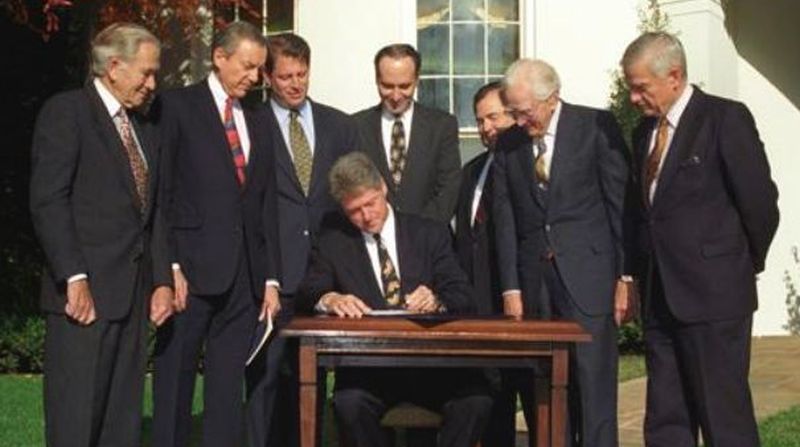
Look at how pleased Bill Clinton was to sign what was then perceived as important civil rights legislation.

The tables have turned. And now all the liberals are remembering how much they love Antonin Scalia. I mean, not really, but to be consistent, those who are denouncing hapless Governor Mike Pence should be extolling Scalia who ushered in the era of "Religious Freedom" legislation when he wrote:
We have never held that an individual's religious beliefs excuse him from compliance with an otherwise valid law prohibiting conduct that the State is free to regulate. On the contrary, the record of more than a century of our free exercise jurisprudence contradicts that proposition. As described succinctly by Justice Frankfurter in Minersville School Dist. Bd. of Educ. v. Gobitis, 310 U.S. 586, 594-595 (1940):
Conscientious scruples have not, in the course of the long struggle for religious toleration, relieved the individual from obedience to a general law not aimed at the promotion or restriction of religious beliefs. The mere possession of religious convictions which contradict the relevant concerns of a political society does not relieve the citizen from the discharge of political responsibilities.
(Footnote omitted.) We first had occasion to assert that principle in Reynolds v. United States, 98 U.S. 145 (1879), where we rejected the claim that criminal laws against polygamy could not be constitutionally applied to those whose religion commanded the practice. "Laws," we said, are made for the government of actions, and while they cannot interfere with mere religious belief and opinions, they may with practices. . . . Can a man excuse his practices to the contrary because of his religious belief? To permit this would be to make the professed doctrines of religious belief superior to the law of the land, and in effect to permit every citizen to become a law unto himself.

Subsequent decisions have consistently held that the right of free exercise does not relieve an individual of the obligation to comply with a valid and neutral law of general applicability on the ground that the law proscribes (or prescribes) conduct that his religion prescribes (or proscribes).
Okay, I'm working my way through this resistance to the topic. What I see is: A different group is activated now and everything looks different. What I feel is: Exquisitely distanced amusement.