I just think this is people who are chronically looking for ways to be upset about things instead of really looking what it is. I believe in protecting religious freedoms. It�s inherent in our state�s constitution. Heck, it�s inherent in our U.S. Constitution, and again, Wisconsin, we�ve done it, and we�re stronger for it.
Said Meade, upon hearing Letterman's "David Letterman's Top Ten Guys Indiana Governor Mike Pence Looks Like" routine, which begins: "This is not the Indiana I remember as a kid. I lived there for 27 years, and folks were folks, and that�s all there was to it. We all breathed the same air, we were all carbon-based life forms. We didn�t care."
Meade was born in Indiana in 1954 and lived there until 1971. "I don't remember anyone, ever, saying it's okay to be gay or that you should treat gay people the same as anyone else. The only thing I ever heard was disparaging or it was joked about and behind the joking was pretty thinly veiled fear. There were no 'out' gays." Meade called Letterman "delusional" and repeats something I said the other day: "Stop otherizing Indiana."
I'm going to defend Letterman a bit, even though I'm sure Meade is right about Hoosiers and homosexuality in the 1950s. One thing is, Letterman makes no effort to understand what RFRA actually says and how it is likely to work in practice: "Honestly, I don't know what [Mike Pence] is talking about." He's operating at a higher level of abstraction, where Hoosiers are stereotypically friendly and nice to everybody. That's what he remembers, and that is the Hoosier brand. Ironically, Mike Pence � in his disastrous turn on ABC's "This Week" � relied on the same branding:
Hoosier -- come on. Hoosiers don't believe in discrimination. I mean the way I was raised, in a small town in Southern Indiana, is you're -- you're kind and caring and respectful to everyone. Anybody that's been in Indiana for five minutes knows that Hoosier hospitality is not a slogan, it's a reality. People tell me when I travel around the country, gosh, I went -- I went to your state and people are so nice....
Yeah, you're the nice people... unlike those people in other states. Well, I just have 2 things to say about that: 1. You're otherizing the people of the other states who have to be less nice for it to be noticeable that your people are so nice, 2. Niceness is a superficial quality, and it's a quality that makes it hard to tell whether the seemingly nice person thinks ill of you or not. Those stereotypical Hoosiers might hate your kind. How would you know?
By the way, has David Letterman ever said disparaging things about gay people on his show? All the jokes in there over the years, going back to the "Tonight" show appearances? I think it would be extraordinary if he didn't. Mocking gay people was, of course, absolutely the norm for Johnny Carson, who expected and got endless laughs over men who are � his words � "light in [their] loafers."
AND: The "Guys Indiana Governor Mike Pence Looks Like" routine isn't consistent with an ethic of friendly kindness and equality. You put up a picture of a man and then throw 10 shots at him for the way he looks. Letterman made a point of not even attempting to understand what Pence was talking about. Let's just make fun of how he looks. Letterman was teaching us that it's just fine to have a gut reaction to a person, to reject the stage in human relations where you see things from the other person's point of view, and to mock him for superficial reasons that have no substance at all.
IN THE COMMENTS: Laslo Spatula came up with 2 answers to my question "By the way, has David Letterman ever said disparaging things about gay people on his show?"
1. In 2011, Letterman joked about Rosie O'Donnell: "The woman she is marrying, her fianc�e, was driving... and her car broke down. And guess what happened? Rosie pulls up right behind her in her tow truck." Rosie wondered what motivated him and added: "I don't remember making fun of you when you had sex with all your interns, Dave. I didn't do that. I didn't make fun of your rampant, throbbing heterosexuality, did I Dave?"
2. In 2008, Letterman had a Top 10 list of "things Jim Carrey will always say 'yes' to" including "A Fan Asking for a Hug, Unless He's a Dude" and then a shot Carrey taking a bath with Larry King and Letterman saying "Those guys are so gay!"
I've got to examine my own soul! I see it � e.g., here � and I know I'm avoiding it. There is something to examine. Why is Indiana getting into so much trouble over a type of law that used to be extremely popular? I guess it has something to do with Hobby Lobby and something to do with all that wedding cake business. There was a time when religionists had the ascendancy, and their pleas for relief from the burdens of generally applicable laws fell on the empathetic ears of conservatives and liberals alike.
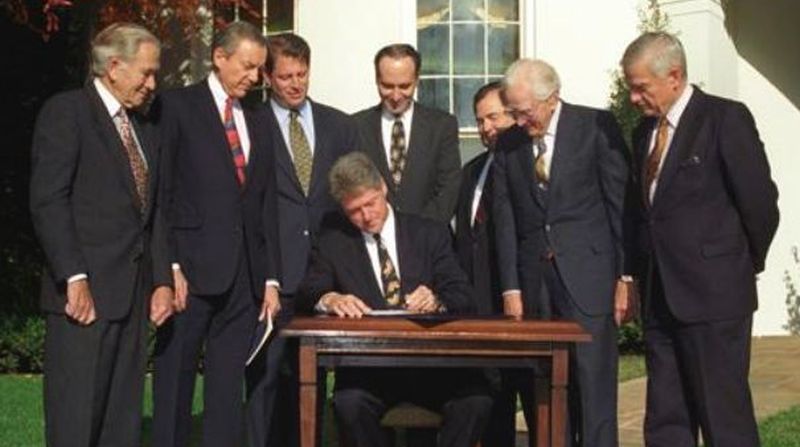
Look at how pleased Bill Clinton was to sign what was then perceived as important civil rights legislation.
The tables have turned. And now all the liberals are remembering how much they love Antonin Scalia. I mean, not really, but to be consistent, those who are denouncing hapless Governor Mike Pence should be extolling Scalia who ushered in the era of "Religious Freedom" legislation when he wrote:
We have never held that an individual's religious beliefs excuse him from compliance with an otherwise valid law prohibiting conduct that the State is free to regulate. On the contrary, the record of more than a century of our free exercise jurisprudence contradicts that proposition. As described succinctly by Justice Frankfurter in Minersville School Dist. Bd. of Educ. v. Gobitis, 310 U.S. 586, 594-595 (1940):
Conscientious scruples have not, in the course of the long struggle for religious toleration, relieved the individual from obedience to a general law not aimed at the promotion or restriction of religious beliefs. The mere possession of religious convictions which contradict the relevant concerns of a political society does not relieve the citizen from the discharge of political responsibilities.
(Footnote omitted.) We first had occasion to assert that principle in Reynolds v. United States, 98 U.S. 145 (1879), where we rejected the claim that criminal laws against polygamy could not be constitutionally applied to those whose religion commanded the practice. "Laws," we said, are made for the government of actions, and while they cannot interfere with mere religious belief and opinions, they may with practices. . . . Can a man excuse his practices to the contrary because of his religious belief? To permit this would be to make the professed doctrines of religious belief superior to the law of the land, and in effect to permit every citizen to become a law unto himself.
Subsequent decisions have consistently held that the right of free exercise does not relieve an individual of the obligation to comply with a valid and neutral law of general applicability on the ground that the law proscribes (or prescribes) conduct that his religion prescribes (or proscribes).
Okay, I'm working my way through this resistance to the topic. What I see is: A different group is activated now and everything looks different. What I feel is: Exquisitely distanced amusement.