"Because today, we've reached the point in our society where, if you do not support same-sex marriage, you are labeled a homophobe and a hater.... After they are done going after individuals, the next step is to argue that the teachings of mainstream Christianity, the catechism of the Catholic Church, is hate speech and there�s a real and present danger.�
Said Marco Rubio.
Showing posts with label homosexuality. Show all posts
Showing posts with label homosexuality. Show all posts
Wednesday, May 27, 2015

Sunday, May 24, 2015
Taking ABBA as seriously as possible.
This essay � at NPR � is so over-the-top about ABBA that it's really very weird. I'll quote the last few sentences:
Gay people particularly respect entertainers who cloak suffering behind carefully constructed artifice because it's a skill most of us are still forced to learn. ABBA concealed the distress of their ditties with as many deliciously gaudy overdubs as the era's analog recording techniques could muster. Embedded in some of the brightest whiteness pop has ever known, ABBA invented their own blues, one that hasn't left the radio. They whispered private anguish in the midst of the party."Embedded in some of the brightest whiteness" refers to the fact that the members of ABBA grew up in 1950s Sweden, where you could only hear 2 hours of music on the radio each day and � amid the "classical music, jazz, Swedish folk, Italian arias, French chanson, German schmaltz and John Philip Sousa" � there might be one pop song but never any "American blues."
Friday, May 15, 2015
"After that sweet birthday fling, I was to have no sex for the next 35 years."
Writes Oliver Sacks in his new memoir "On the Move," reviewed in the NYT by Andrew Solomon, who complains that Sacks's "transition into celibacy is presented without explication." Sacks has known that he is gay since at least when he was 18 (in 1951), when he told his father the news. His father told his mother, and his mother "came down with a face of thunder, a face I had never seen before. 'You are an abomination,' she said. 'I wish you had never been born.'"
Then she left and did not speak to me for several days. When she did speak, there was no reference to what she had said (nor did she ever refer to the matter again), but something had come between us. My mother, so open and supportive in most ways, was harsh and inflexible in this area. A Bible reader like my father, she loved the Psalms and the Song of Solomon but was haunted by the terrible verses in Leviticus: "Thou shall not lie with mankind, as with womankind: it is abomination."That's from the book. Solomon wonders why Sacks was celibate for 35 years:
He explains only that he had trouble with �bonding, belonging and believing.� Sacks has cared for many people � especially his patients � but the kind of love on which marriages are based seems to have been not merely elusive, but bewildering to him (though he has been seeing the same psychoanalyst for nearly 50 years). Sacks did not so much avoid convention as fail to notice it; he understands difficult facets of the human experience with singular clarity, but emotional rules that are legible to most people seem to bewilder him.By the way, the word "celibacy" (or "celibate") does not appear in the book. Nor is there "sexless." And "no sex" only appears that once (quoted in the post title). Is Sacks really as bewildered as Solomon seems to think? I'm looking at the book � which I just bought � and I see that Sacks says that he "regarded [his] sexuality as nobody�s business but [his] own, not a secret, but not to be talked about" and that one closest friends when he was a young man told him he thought Sacks was "asexual."
We are all creatures of our upbringings, our cultures, our times. And I have needed to remind myself, repeatedly, that my mother was born in the 1890s and had an Orthodox [Jewish] upbringing and that in England in the 1950s homosexual behavior was treated not only as a perversion but as a criminal offense. I have to remember, too, that sex is one of those areas� like religion and politics� where otherwise decent and rational people may have intense, irrational feelings. My mother did not mean to be cruel, to wish me dead. She was suddenly overwhelmed, I now realize, and she probably regretted her words or perhaps partitioned them off in a closeted part of her mind.I think that's some explication of what Solomon calls the "transition into celibacy." But many readers � including me � would like to see the subject of celibacy examined by someone with such a fine mind and such long experience with the condition. There must have been some good in it, to stay with it for 35 years.
But her words haunted me for much of my life and played a major part in inhibiting and injecting with guilt what should have been a free and joyous expression of sexuality.
Thursday, May 14, 2015
"David Hockney has a fag in one hand, a mug of tea in the other, fish and chips and mushy peas in front of him, and he is surrounded by his own work."
"... Hockney is such a militant smoker you sense he sparks up even when he doesn�t fancy one, just to piss people off. His father, Kenneth, was just as militant in his non-smoking. 'I have now outlived him. I am nearly 78.� He puffs and grins.... He waves his cigarette at me. 'Do you smoke?' he asks, as if challenging me to a duel. I find myself apologising for having stopped, and he looks at me with a disappointment bordering on contempt � though he seems slightly pacified when I ask for a whisky. 'Bohemia was against the suburbs, and now the suburbs have taken over,' he says. 'I mean, the anti-smoking thing is all anti-bohemia. Bohemia is gone now. When people say, well wasn�t it amazing saying you were gay in 1960, I point out, well, I lived in bohemia, and bohemia is a tolerant place. You can�t have a smoke-free bohemia. You can�t have a drug-free bohemia. You can�t have a drink-free bohemia. Now they�re all worried about their fucking curtains, sniffing curtains for tobacco and stuff like that.' Does he think gay life has become more conservative in recent years? 'Yes. I suppose it�s that they want to be ordinary � they want to fit in. Well, I didn�t care about that. I didn�t care about fitting in. Everywhere is so conservative.'"
A tiny snippet of "David Hockney: �'Just because I�m cheeky, doesn�t mean I�m not serious'/At 77, and with two new exhibitions, David Hockney is more prolific and outspoken than ever. He tells us why he stopped painting after the death of his assistant � and why, despite a 9pm bedtime, he�s still a rebel at heart."
A tiny snippet of "David Hockney: �'Just because I�m cheeky, doesn�t mean I�m not serious'/At 77, and with two new exhibitions, David Hockney is more prolific and outspoken than ever. He tells us why he stopped painting after the death of his assistant � and why, despite a 9pm bedtime, he�s still a rebel at heart."
Tuesday, May 12, 2015
"What Was Gay?/In an increasingly accepting world, homosexual men are all too eager to leave their campy, cruising past behind."
"But the price of equality shouldn�t be conformity," writes J. Bryan Lowder in a long Slate essay, which I got to after watching the video at "Cover Girl Don�t Cover Boy: A Transformative Conversation on Drag�s Role in Gay Culture" (which ends with a reference to one of my all-time favorite movies, "Romy and Michele's High School Reunion").
From the "What Was Gay" essay:
From the "What Was Gay" essay:
This move away from broad-brush gay stereotypes is wise to a point. Ascribing an obligatory cultural component to homosexuality has caused a range of problems, from the merely annoying Oh you�re gay? Let�s go shopping!�variety to the more pernicious example of admission to safer, queer-only housing in prison being determined based on tests of �gay insider� knowledge or behaviors that not all queer people necessarily possess. Clearly, a person�s homosexuality should not be taken as evidence of any special affiliation, just as heterosexuals, united only by their sexual connection and propensity for procreation, are never assumed to share anything else. This has been one of the key arguments in the �we are normal� case for equality�and it�s been largely successful. Though the job is not totally complete, it feels like we are working as fast as we can to build what gay academic and activist Dennis Altman imagines in his provocatively titled The End of the Homosexual?: a world in which we no longer see �homosexuality as a primary marker of identity, so that sexual preference comes to be regarded as largely irrelevant, and thus not the basis for either community or identity.�Let's go shopping?
Saturday, May 2, 2015
"Though American shows once dominated the East African television schedule..."
"... familiar themes like village-to-city migration and patriarchal Christian values have made the soap operas from the Philippines more attractive to the Ugandan audience."
�You need to make sure that there's some element of African kind of living, the life that we see everyday,� says Robert Semakula, a programmer for Bukedde TV, one of Uganda�s top stations that runs �Be Careful With My Heart�. Each year for the last three years, Mr. Semakula has sorted through a catalogue of shows from foreign media, and lately, Filipino soaps have made the pick....
Filipino soaps find an audience in Uganda because they adhere to a common formula, described by Graham, as a "Cinderella story, a young girl in the country who�s relatively innocent and looks after her relatives, and she�s immediately transported to a place of great corruption, a city or a rich family." Muwonge says these shows connect because they deal with poverty and other issues affecting Ugandans' everyday lives....
Uganda is notorious for its intolerance of gay people and has long had antigay laws. So when Filipino soap operas � which have recently begun to show positive portrayals of gay culture � show two men in a relationship, the station often cuts the scene or storyline.
�The audience won't understand that,� Semakula says.
Wednesday, April 29, 2015
"I mean, if Sue loves Joe and Tom loves Joe, Sue can marry him and Tom can't. And the difference is based upon their different sex."
So said Chief Justice Roberts, in part of yesterday's oral argument which I discussed in some detail earlier this morning.
I just wanted to write a separate post to beat you over the head with the profound accuracy of the Chief's statement.
The government, in banning same-sex marriage, does nothing to ascertain that couples are sexually attracted to each other.
The Sue that loves Joe could be a lesbian, and the Tom who loves Joe could be heterosexual.
Maybe Joe is a very desirable marriage partner for reasons that have nothing to do with a desire to have sex with him. Maybe he's rich and powerful and has a wonderful circle of friends. This Joe, perhaps, loves to cook and is a great cook, and he's got an extensive wine cellar. Maybe he loves just the kind of movies/sports that Sue/Tom loves, and he keeps up an endlessly entertaining stream of conversation, full of witty observations and howlingly funny jokes. And he's perfectly happy to allow Sue/Tom to pursue sexual adventures. Go right ahead! Have them! And come back home to Joe's delicious late-night supper and drink some of Joe's top-notch wine and you can talk about sex for hours.
The government has no idea, and the government should have no idea.
Monday, April 20, 2015
Should NYT columnist Frank Bruni get in trouble for calling the relationship between Hillary Clinton and Huma Abedin "marsupial"?
Bruni wrote: "'Everyday Americans' specifically included 'everyday Iowans' when Clinton traveled across the heartland in her Scooby van with Huma Abedin, who clings to her so tightly that their relationship could be called marsupial."
Instapundit says: "HUH. I WONDER WHAT HE�S TRYING TO SAY WITH THAT?" I wonder what Instapundit is trying to say with that. I assume what I assumed when I read Bruni: He's saying � with deniability � that Hillary and Huma are lesbians.
Now, Frank Bruni himself is openly gay, so there's no reason to imagine him to be antagonistic to lesbians or to think it's amusing to float the rumor that the 2 women are lesbians. Or... maybe not. It's possible that an openly gay person would want to pressure closeted gay people to come out. Bruni must know that he's giving air to a rumor that some anti-Hillary people get off on.
And to use an animal to say something about a person...

... you are inviting trouble if you're using that animal to represent membership in a traditionally discriminated-against group.
Instapundit says: "HUH. I WONDER WHAT HE�S TRYING TO SAY WITH THAT?" I wonder what Instapundit is trying to say with that. I assume what I assumed when I read Bruni: He's saying � with deniability � that Hillary and Huma are lesbians.
Now, Frank Bruni himself is openly gay, so there's no reason to imagine him to be antagonistic to lesbians or to think it's amusing to float the rumor that the 2 women are lesbians. Or... maybe not. It's possible that an openly gay person would want to pressure closeted gay people to come out. Bruni must know that he's giving air to a rumor that some anti-Hillary people get off on.
And to use an animal to say something about a person...
... you are inviting trouble if you're using that animal to represent membership in a traditionally discriminated-against group.
Friday, April 17, 2015
"In interviews, Ryan has characterized his #BottomForHillary movement as 'just a fun way for people to show support for a presidential candidate'..."
"... but many gays aren�t laughing. A Huffington Post commenter decried the phrase, writing, 'we do not need this type of exposure, as it does not help our LGBT community at all,' and Zach Stafford has penned a screed against the thing in the Guardian, declaring that it relies on a logic of 'bottom-shaming,' the essentially misogynistic notion that bottoming is more effeminate�and therefore a lesser act�than topping. Stafford�s point is well-taken (I definitely share his dislike for the way bottom-shaming often creeps into gay men�s discourse), but I wonder if it�s totally fair...."
From a surprisingly long piece at Slate by J. Bryan Lowder called "Should Gays Bottom for Hillary?"
From a surprisingly long piece at Slate by J. Bryan Lowder called "Should Gays Bottom for Hillary?"
Saturday, April 11, 2015
NYC cab driver fined $15,000 for telling his 2 women passengers not to kiss.
"TV producer Christina Spitzer and her actress girlfriend, Kassie Thornton, said they barely exchanged a peck in the back seat early into their ride when hack Mohammed Dahbi became �enraged."
At a hearing last month, Dahbi told an unsympathetic administrative-law judge that Spitzer and Thornton were doing more than just G-rated canoodling. He said they were kissing �heavily� and �touching all over each other� � including �on the chest and the breast.�...
Each woman was awarded $5,000 for emotional distress, in addition to a $5,000 fine Dahbi was ordered to pay the city.Dahbi was found guilty of denying them a �public accommodation due to their sexual orientation.�
"[T]he first 800-page instalment of a two-part history of America that tells of the secret gay life of figures from Alexander Hamilton, George Washington and Abraham Lincoln to Mark Twain, Herman Melville and Richard Nixon."
From activist/writer Larry Kramer.
ADDED: The link goes to an article in The Guardian which has the title "Were Lincoln and Nixon gay? The �history� book that is dividing America" and, right under that, this set of pictures:

The caption under that is: "Abraham Lincoln, left and Richard Nixon. 'It may look like fiction, but to me, it�s not,' says author Larry Kramer of his book." One gets the sense that Kramer is playing an imaginative game of hypothesizing that this or that historical figure was gay. He says:
"Most histories have been written by straight people. There has never been any history book written where the gay people have been in the history from the beginning.It�s ridiculous to think we haven�t been here for ever."Of course, he's right about that. There were gay people who hid it, so why not speculate about which ones were gay? What evidence is there? Lincoln and Nixon look so grim in those photographs. Maybe it was the stress and pain of denying and hiding their true sexuality.
Thursday, April 2, 2015
"The Indiana he knew as a kid was completely homophobic. Take my word for it."
Said Meade, upon hearing Letterman's "David Letterman's Top Ten Guys Indiana Governor Mike Pence Looks Like" routine, which begins: "This is not the Indiana I remember as a kid. I lived there for 27 years, and folks were folks, and that�s all there was to it. We all breathed the same air, we were all carbon-based life forms. We didn�t care."
Meade was born in Indiana in 1954 and lived there until 1971. "I don't remember anyone, ever, saying it's okay to be gay or that you should treat gay people the same as anyone else. The only thing I ever heard was disparaging or it was joked about and behind the joking was pretty thinly veiled fear. There were no 'out' gays." Meade called Letterman "delusional" and repeats something I said the other day: "Stop otherizing Indiana."
I'm going to defend Letterman a bit, even though I'm sure Meade is right about Hoosiers and homosexuality in the 1950s. One thing is, Letterman makes no effort to understand what RFRA actually says and how it is likely to work in practice: "Honestly, I don't know what [Mike Pence] is talking about." He's operating at a higher level of abstraction, where Hoosiers are stereotypically friendly and nice to everybody. That's what he remembers, and that is the Hoosier brand. Ironically, Mike Pence � in his disastrous turn on ABC's "This Week" � relied on the same branding:
By the way, has David Letterman ever said disparaging things about gay people on his show? All the jokes in there over the years, going back to the "Tonight" show appearances? I think it would be extraordinary if he didn't. Mocking gay people was, of course, absolutely the norm for Johnny Carson, who expected and got endless laughs over men who are � his words � "light in [their] loafers."
AND: The "Guys Indiana Governor Mike Pence Looks Like" routine isn't consistent with an ethic of friendly kindness and equality. You put up a picture of a man and then throw 10 shots at him for the way he looks. Letterman made a point of not even attempting to understand what Pence was talking about. Let's just make fun of how he looks. Letterman was teaching us that it's just fine to have a gut reaction to a person, to reject the stage in human relations where you see things from the other person's point of view, and to mock him for superficial reasons that have no substance at all.
IN THE COMMENTS: Laslo Spatula came up with 2 answers to my question "By the way, has David Letterman ever said disparaging things about gay people on his show?"
1. In 2011, Letterman joked about Rosie O'Donnell: "The woman she is marrying, her fianc�e, was driving... and her car broke down. And guess what happened? Rosie pulls up right behind her in her tow truck." Rosie wondered what motivated him and added: "I don't remember making fun of you when you had sex with all your interns, Dave. I didn't do that. I didn't make fun of your rampant, throbbing heterosexuality, did I Dave?"
2. In 2008, Letterman had a Top 10 list of "things Jim Carrey will always say 'yes' to" including "A Fan Asking for a Hug, Unless He's a Dude" and then a shot Carrey taking a bath with Larry King and Letterman saying "Those guys are so gay!"
Meade was born in Indiana in 1954 and lived there until 1971. "I don't remember anyone, ever, saying it's okay to be gay or that you should treat gay people the same as anyone else. The only thing I ever heard was disparaging or it was joked about and behind the joking was pretty thinly veiled fear. There were no 'out' gays." Meade called Letterman "delusional" and repeats something I said the other day: "Stop otherizing Indiana."
I'm going to defend Letterman a bit, even though I'm sure Meade is right about Hoosiers and homosexuality in the 1950s. One thing is, Letterman makes no effort to understand what RFRA actually says and how it is likely to work in practice: "Honestly, I don't know what [Mike Pence] is talking about." He's operating at a higher level of abstraction, where Hoosiers are stereotypically friendly and nice to everybody. That's what he remembers, and that is the Hoosier brand. Ironically, Mike Pence � in his disastrous turn on ABC's "This Week" � relied on the same branding:
Hoosier -- come on. Hoosiers don't believe in discrimination. I mean the way I was raised, in a small town in Southern Indiana, is you're -- you're kind and caring and respectful to everyone. Anybody that's been in Indiana for five minutes knows that Hoosier hospitality is not a slogan, it's a reality. People tell me when I travel around the country, gosh, I went -- I went to your state and people are so nice....Yeah, you're the nice people... unlike those people in other states. Well, I just have 2 things to say about that: 1. You're otherizing the people of the other states who have to be less nice for it to be noticeable that your people are so nice, 2. Niceness is a superficial quality, and it's a quality that makes it hard to tell whether the seemingly nice person thinks ill of you or not. Those stereotypical Hoosiers might hate your kind. How would you know?
By the way, has David Letterman ever said disparaging things about gay people on his show? All the jokes in there over the years, going back to the "Tonight" show appearances? I think it would be extraordinary if he didn't. Mocking gay people was, of course, absolutely the norm for Johnny Carson, who expected and got endless laughs over men who are � his words � "light in [their] loafers."
AND: The "Guys Indiana Governor Mike Pence Looks Like" routine isn't consistent with an ethic of friendly kindness and equality. You put up a picture of a man and then throw 10 shots at him for the way he looks. Letterman made a point of not even attempting to understand what Pence was talking about. Let's just make fun of how he looks. Letterman was teaching us that it's just fine to have a gut reaction to a person, to reject the stage in human relations where you see things from the other person's point of view, and to mock him for superficial reasons that have no substance at all.
IN THE COMMENTS: Laslo Spatula came up with 2 answers to my question "By the way, has David Letterman ever said disparaging things about gay people on his show?"
1. In 2011, Letterman joked about Rosie O'Donnell: "The woman she is marrying, her fianc�e, was driving... and her car broke down. And guess what happened? Rosie pulls up right behind her in her tow truck." Rosie wondered what motivated him and added: "I don't remember making fun of you when you had sex with all your interns, Dave. I didn't do that. I didn't make fun of your rampant, throbbing heterosexuality, did I Dave?"
2. In 2008, Letterman had a Top 10 list of "things Jim Carrey will always say 'yes' to" including "A Fan Asking for a Hug, Unless He's a Dude" and then a shot Carrey taking a bath with Larry King and Letterman saying "Those guys are so gay!"
Sunday, March 29, 2015
Why am I avoiding this Indiana RFRA story?
I've got to examine my own soul! I see it � e.g., here � and I know I'm avoiding it. There is something to examine. Why is Indiana getting into so much trouble over a type of law that used to be extremely popular? I guess it has something to do with Hobby Lobby and something to do with all that wedding cake business. There was a time when religionists had the ascendancy, and their pleas for relief from the burdens of generally applicable laws fell on the empathetic ears of conservatives and liberals alike.

Look at how pleased Bill Clinton was to sign what was then perceived as important civil rights legislation.
The tables have turned. And now all the liberals are remembering how much they love Antonin Scalia. I mean, not really, but to be consistent, those who are denouncing hapless Governor Mike Pence should be extolling Scalia who ushered in the era of "Religious Freedom" legislation when he wrote:
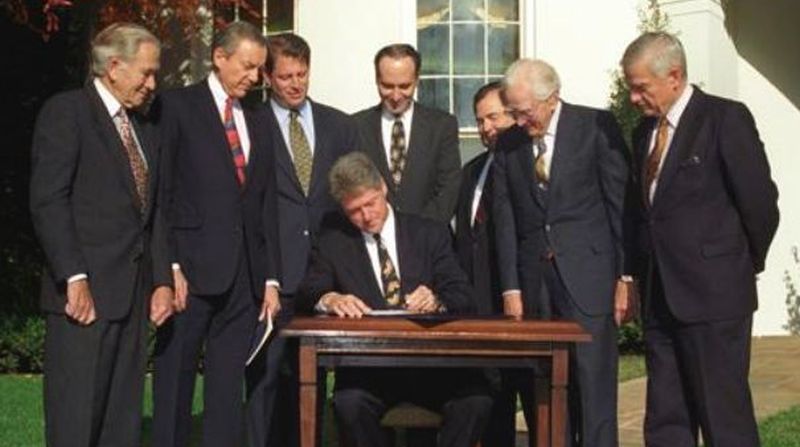
Look at how pleased Bill Clinton was to sign what was then perceived as important civil rights legislation.
The tables have turned. And now all the liberals are remembering how much they love Antonin Scalia. I mean, not really, but to be consistent, those who are denouncing hapless Governor Mike Pence should be extolling Scalia who ushered in the era of "Religious Freedom" legislation when he wrote:
We have never held that an individual's religious beliefs excuse him from compliance with an otherwise valid law prohibiting conduct that the State is free to regulate. On the contrary, the record of more than a century of our free exercise jurisprudence contradicts that proposition. As described succinctly by Justice Frankfurter in Minersville School Dist. Bd. of Educ. v. Gobitis, 310 U.S. 586, 594-595 (1940):Okay, I'm working my way through this resistance to the topic. What I see is: A different group is activated now and everything looks different. What I feel is: Exquisitely distanced amusement.Conscientious scruples have not, in the course of the long struggle for religious toleration, relieved the individual from obedience to a general law not aimed at the promotion or restriction of religious beliefs. The mere possession of religious convictions which contradict the relevant concerns of a political society does not relieve the citizen from the discharge of political responsibilities.(Footnote omitted.) We first had occasion to assert that principle in Reynolds v. United States, 98 U.S. 145 (1879), where we rejected the claim that criminal laws against polygamy could not be constitutionally applied to those whose religion commanded the practice. "Laws," we said, are made for the government of actions, and while they cannot interfere with mere religious belief and opinions, they may with practices. . . . Can a man excuse his practices to the contrary because of his religious belief? To permit this would be to make the professed doctrines of religious belief superior to the law of the land, and in effect to permit every citizen to become a law unto himself.
Subsequent decisions have consistently held that the right of free exercise does not relieve an individual of the obligation to comply with a valid and neutral law of general applicability on the ground that the law proscribes (or prescribes) conduct that his religion prescribes (or proscribes).
Thursday, March 5, 2015
"In one sentence I would say we are all children of a Heavenly Father who loves us equally."
"Oh, if the country could be like this... This bill is a model � not just of legislation, but more importantly of how to bridge the cultural rift tearing America apart."
"We have to find a way to live together. We just can't endlessly be litigating against each other. We can't endlessly be in culture wars. If you want to know why Utah got it right, it's because they actually called a truce in the culture war."
"We have to find a way to live together. We just can't endlessly be litigating against each other. We can't endlessly be in culture wars. If you want to know why Utah got it right, it's because they actually called a truce in the culture war."
Subscribe to:
Posts (Atom)