[Ted Gioia�s "Love Songs: The Hidden History"] touches in passing upon the love song�s evolutionary brief�that is, to encourage men and women down the ages to have sex with each other.... [O]ne of his arguments is that the basic elements have been there from the beginning. It�s hard not to agree with him, really, when Egyptologists are finding amid the pottery shards and crumbling papyri lines like If only I were the laundryman � / Then I�d rub my body with her cast-off garments. Gioia credits women with the greatest breakthroughs in love-song self-expression: �Women were the innovators and men the disseminators�� which sounds anatomically correct, at least. Love shook my senses, / Like wind crashing on the mountain oaks. That�s Sappho, or the composite forensic entity known as Sappho, sounding like Kelly Clarkson.
Saturday, February 28, 2015
"The genesis of the love song would seem to lie somewhere in the fertility rites of the ancient world..."
"... the Sumerians, for example, had a number of hymns/love songs to celebrate the sacred marriage of the king (human) to the goddess (immortal), these nuptials being conducive to a rich harvest, cultural plenitude, satellite dishes for everyone, and so on..."

"Is Leonard Nimoy the first example of a 'famous last tweet?' If not, what are some others?"
A question on Reddit. Nimoy's last tweet was: "A life is like a garden, Perfect moments can be had, but not preserved, except in memory." I don't see how you can call that "famous" when he just died. Would you remember that 10 years from now?
Among the answers: "The last tweet of that poor Notre Dame student who died on the scissor lift filming football practice was... 'Gust of wind up to 60mph ... I guess I've lived long enough.'" That's the other meaning of the phrase "famous last words." There, stress belongs on last, not famous. It's something a person who isn't planning to die says that, in retrospect, speaks to the circumstances of the death.
Another answer is Roger Ebert's "So on this day of reflection I say again, thank you for going on this journey with me. I'll see you at the movies." That's like Nimoy's. Someone who is planning to die frames an apt statement on the way out.
Let's not mix up the 2 kinds of famous last words. Or are there more than 2?
ADDED: The expression "famous last words" is most useful as something to say to a living person who has just said something that you're picturing could be something that is said right before doing something deadly.
AND: The fire extinguisher's empty. Get the hairspray!
Among the answers: "The last tweet of that poor Notre Dame student who died on the scissor lift filming football practice was... 'Gust of wind up to 60mph ... I guess I've lived long enough.'" That's the other meaning of the phrase "famous last words." There, stress belongs on last, not famous. It's something a person who isn't planning to die says that, in retrospect, speaks to the circumstances of the death.
Another answer is Roger Ebert's "So on this day of reflection I say again, thank you for going on this journey with me. I'll see you at the movies." That's like Nimoy's. Someone who is planning to die frames an apt statement on the way out.
Let's not mix up the 2 kinds of famous last words. Or are there more than 2?
ADDED: The expression "famous last words" is most useful as something to say to a living person who has just said something that you're picturing could be something that is said right before doing something deadly.
AND: The fire extinguisher's empty. Get the hairspray!
"Stop Scott Walker, Ann."
In my email this morning (sent, as usual for the DNC, to my university address):

I love the way the big, bright, white letters are used to create the deniable, subliminal message: "SCOTT WALKER TERRORISTS."
I love the way the big, bright, white letters are used to create the deniable, subliminal message: "SCOTT WALKER TERRORISTS."
Why Stephen Breyer is my favorite Supreme Court Justice.
I love his crafty-casual unfolding of an absolutely-to-the-point, devastating question, on nice display in EEOC v. Abercrombie & Fitch (which is a case about the store's declining to hire a woman who interviewed in a headscarf):
That's just one example of his style of questioning. That's his long form attack, which tends to come after lying in wait. There's also the delightful short form of attack: "I'm with you only where they correctly believe that, dah, dah, dah, or understand dah, dah, dah, or no."
That's just one example of his style of questioning. That's his long form attack, which tends to come after lying in wait. There's also the delightful short form of attack: "I'm with you only where they correctly believe that, dah, dah, dah, or understand dah, dah, dah, or no."
"You have to feel a little sorry these days for professors married to their former students. They used to be respectable citizens�leaders in their fields, department chairs, maybe even a dean or two..."
"... and now they�re abusers of power avant la lettre. I suspect you can barely throw a stone on most campuses around the country without hitting a few of these neo-miscreants. Who knows what coercions they deployed back in the day to corral those students into submission; at least that�s the fear evinced by today�s new campus dating policies. And think how their kids must feel! A friend of mine is the offspring of such a coupling�does she look at her father a little differently now, I wonder. It�s been barely a year since the Great Prohibition took effect in my own workplace. Before that, students and professors could date whomever we wanted; the next day we were off-limits to one another�verboten, traife, dangerous (and perhaps, therefore, all the more alluring)."
So begins Laura Kipnis, in a piece titled "Sexual Paranoia Strikes Academe."
For the record, I do not think professors should have sexual relationships with students, and therefore I support that particular "Great Prohibition," but I think Kipnis's writing is interesting, and that paragraph hits on something that had been pretty obvious for a long time: It's hard to ban something that should be banned when to do so casts aspersions on the marriages of many prestigious professors.
So begins Laura Kipnis, in a piece titled "Sexual Paranoia Strikes Academe."
For the record, I do not think professors should have sexual relationships with students, and therefore I support that particular "Great Prohibition," but I think Kipnis's writing is interesting, and that paragraph hits on something that had been pretty obvious for a long time: It's hard to ban something that should be banned when to do so casts aspersions on the marriages of many prestigious professors.
"The Intercept media executives and staff weren�t fans of their own reporting on the case featured in the wildly popular podcast Serial, delaying stories because they were 'siding with The Man'..."
"... former Intercept senior investigative reporter Ken Silverstein wrote in POLITICO Magazine."
�I came to realize that the system working correctly�and the right people going to jail�isn�t a good narrative to tell at The Intercept,� Silverstein wrote.From Silverstein's piece:
Publishing the Serial stories was a huge headache: There were constant delays and frustrations getting them out, even after it became clear they were drawing huge traffic. Our internal critics believed that Natasha and I had taken the side of the prosecutors�and hence the state. That support was unacceptable at a publication that claimed it was entirely independent and would be relentlessly adversarial towards The Man. That held true even in this case, when The Man successfully prosecuted a killer and sent him to jail.
Some colleagues, like Jeremy Scahill, were upset after the first installment of Natasha�s interviews with Jay, the state�s flawed-but-convincing key witness, and our co-bylined two-part interview with the lead prosecutor, Kevin Urick, both of whom had refused to speak to Sarah Koenig for her Serial podcast. Jeremy even threatened to quit over the second installment, according to two of my colleagues who witnessed what they described as his �temper tantrum� in the New York office. He told them he couldn�t believe that we�d so uncritically accepted the state�s view of the murder�even though our stories were backed up by our own research, our unique reporting and our reading of court documents. One day at the office, frustrated, Natasha wrote �Team Adnan� on a sign on Jeremy�s office door.
"Today is September 30th, also known as Blasphemy Rights day."
"This day is dedicated to those who are systematically being persecuted, harassed, or killed for their simple expression of Freethought (more precisely, for their �blasphemous� views towards religion)."
Avijit Roy left his home in Atlanta for a speaking engagement in Dhaka, Bangladesh. Last Thursday:
Today, we state clearly that considering apostasy to be a criminal offense in state level in fact is an inexcusable offense. If being religious is someone�s right, then being critical to religion is also one�s right. There is nothing wrong to be critical to any idea or ideology, as CFI aptly put on its Blasphemy day banner � �Ideas do not need rights, People do�!So wrote Avijit Roy on his blog Mukto Mona, on September 30, 2013.
Avijit Roy left his home in Atlanta for a speaking engagement in Dhaka, Bangladesh. Last Thursday:
As he walked back from the book fair, assailants plunged machetes and knives into Roy and his wife, killing him and leaving her bloodied and missing a finger.
Afterward, an Islamist group "Ansar Bangla-7" reportedly tweeted, "Target Down here in Bangladesh."
"It is a slippery slope if the government is now going to prosecute people under a manslaughter � a 20-year felony charge � for not preventing those who want to commit suicide..."
"... and that�s what they�re trying to do here."
Asked if they thought [17-year-old Michelle] Carter�s messages convinced [18-year-old Conrad] Roy to kill himself, his grandfather Conrad Roy Sr. said, �Her texts had a big influence on what happened.�
"Long before being nerdy was cool, there was Leonard Nimoy."
"Cool, logical, big-eared and level-headed, the center of Star Trek's optimistic, inclusive vision of humanity's future."
Said the cool and nerdy, big-eared Barack Obama.
Said the cool and nerdy, big-eared Barack Obama.
"So" is the new "well."
So, I wanted to write a post with that title after reaching my tipping point listening to 2 things yesterday: 1. Jeb Bush doing a Q&A at CPAC and beginning nearly every answer with "So...," and 2. The Supreme Court oral argument in EEOC v. Abercrombie & Fitch, with the lawyer for the government repeatedly beginning his answers with "So..." (and "So, Your Honor").
So, having conceived of that title for a blog post on a topic that has been stewing on the back burner of my mind, I googled those words and found them in a 2010 essay by Anand Giridharadas (in the NYT) called "Follow My Logic? A Connective Word Takes the Lead":
So, having conceived of that title for a blog post on a topic that has been stewing on the back burner of my mind, I googled those words and found them in a 2010 essay by Anand Giridharadas (in the NYT) called "Follow My Logic? A Connective Word Takes the Lead":
�So� may be the new �well,� �um,� �oh� and �like.� No longer content to lurk in the middle of sentences, it has jumped to the beginning, where it can portend many things: transition, certitude, logic, attentiveness, a major insight....Giridharadas traces the tic to 1990s-era Silicon Valley, where software-oriented minds visualize "conversation as a logical, unidirectional process � if this, then that."
One can dredge up ancient instances of �so� as a sentence starter. In his 14th-century poem �Troilus and Criseyde,� Chaucer launched a verse with, �So on a day he leyde him doun to slepe. ...� But for most of its life, �so� has principally been a conjunction, an intensifier and an adverb.
What is new is its status as the favored introduction to thoughts, its encroachment on the territory of �well,� �oh,� �um� and their ilk.
This logical tinge to �so� has followed it out of software. Compared to �well� and �um,� starting a sentence with �so� uses the whiff of logic to relay authority. Whereas �well� vacillates, �so� declaims....Too phallocratic? Well... I'm saying "well" like a person of the 80s... consider the theory of the linguist Galina Bolden, who's done scholarly writing on the topic of "so":
She believes that �so� is also about the culture of empathy that is gaining steam as the world embraces the increasing complexity of human backgrounds and geographies.And then there's Michael Erard, author of "Um...: Slips, Stumbles, and Verbal Blunders, and What They Mean":
To begin a sentence with �oh,� she said in an e-mail message, is to focus on what you have just remembered and your own concerns. To begin with �so,� she said, is to signal that one�s coming words are chosen for their relevance to the listener.
The ascendancy of �so,� Dr. Bolden said, �suggests that we are concerned with displaying interest for others and downplaying our interest in our own affairs.�
The rise of �so,� he said via e-mail, is �another symptom that our communication and conversational lives are chopped up and discontinuous in actual fact, but that we try in several ways to sew them together � or �so� them together, as it were � in order to create a continuous experience.�So it is written...
Friday, February 27, 2015
Stalin World.
Here's a documentary about the Lithuanian theme park Grutas Park � AKA "Stalin World" � which we were talking about this morning in connection with the ISIS destruction of ancient sculptures. Here we see Soviet era sculptures preserved in a tourist-attraction garden setting that many Lithuanians find quite offensive.
Thanks to Irene for pointing me there. And no thanks to the NYT for picturing 2 of the Grutas Park sculptures in a slide show about how aging Americans can absorb Euro-culture through the wonders of Airbnb.
Thanks to Irene for pointing me there. And no thanks to the NYT for picturing 2 of the Grutas Park sculptures in a slide show about how aging Americans can absorb Euro-culture through the wonders of Airbnb.
"Boy, Blowing Up A DNC Media Hit Job On Scott Walker In Realtime Sure Is Fun!"
"The Latest Attempt To Launch A New Walker Smear Crashes & Burns On The Launch Pad. And There Was Much Rejoicing."
As it so happens, this Jezebel writer, Natasha Vargas-Cooper, either didn't do any research at all on this piece or she deliberately left out the whole story.(Via Instapundit.)
As it so happens, there is a pretty damn good reason Scott Walker deleted these [sexual assault] reporting requirements.
He did it because - get this! - the University of Wisconsin *asked* him to.
Jeb Bush at CPAC.
Watch live, here, beginning right now.
UPDATE: It's over now. I watched it. Here's what I remember:
1. He asked if he could be your second choice.
2. He had that young-person's conversational tic of beginning every answer with "So." (He didn't do a speech, but only took questions from Sean Hannity.)
3. He looked presentable and reasonably trim, but he could use a better tailored suit... or is a too-big suit some way of covering flaws or seeming to be an un-rich guy?
4. He's got a good pitch about improving K-12 education in Florida, and he expresses pride in ending affirmative action by executive order.
5. In the instant word association portion of the questions, his response to "Obama" was "failed President."
6. Best but dubious effort at humor: When Hannity said he had one more question, Jeb said "boxers." (Bill Clinton's answer to the famously inappropriate question, by the way, was "Usually briefs. I can't believe she did that." Obama's answer was: "I don't answer those humiliating questions. But whichever one it is, I look good in 'em.")
7. This was the first time � as far as I remember � that I ever spent any time actually listening to Jeb Bush. So... what's my impression? He seems solid and substantial. Nothing particularly negative. I never expect to agree with everything a presidential candidate stands for. You'd have to reshuffle what the 2 parties are for that to happen. And Jeb only wants to be my second choice.
UPDATE: It's over now. I watched it. Here's what I remember:
1. He asked if he could be your second choice.
2. He had that young-person's conversational tic of beginning every answer with "So." (He didn't do a speech, but only took questions from Sean Hannity.)
3. He looked presentable and reasonably trim, but he could use a better tailored suit... or is a too-big suit some way of covering flaws or seeming to be an un-rich guy?
4. He's got a good pitch about improving K-12 education in Florida, and he expresses pride in ending affirmative action by executive order.
5. In the instant word association portion of the questions, his response to "Obama" was "failed President."
6. Best but dubious effort at humor: When Hannity said he had one more question, Jeb said "boxers." (Bill Clinton's answer to the famously inappropriate question, by the way, was "Usually briefs. I can't believe she did that." Obama's answer was: "I don't answer those humiliating questions. But whichever one it is, I look good in 'em.")
7. This was the first time � as far as I remember � that I ever spent any time actually listening to Jeb Bush. So... what's my impression? He seems solid and substantial. Nothing particularly negative. I never expect to agree with everything a presidential candidate stands for. You'd have to reshuffle what the 2 parties are for that to happen. And Jeb only wants to be my second choice.
Goodbye to Leonard Nimoy.
The author of "I Am Not Spock" (1977) and "I Am Spock" (1995) has died at the age of 83.
What's so bad about Scott Walker's "If I can take on 100,000 protesters, I can do the same across the globe"?
"I think the bust of Fighting Bob La Follette is kind of Soviet-like," says Meade, reading the previous post about the Islamic iconoclasm in Mosul and anti-Soviet iconoclasm in the former Soviet states (and the preservation of Soviet sculptures in Lithuania).
Here's a picture I took of the monumental head on February 25, 2011, a little over a week after the big protests had begun in and around the Wisconsin capitol:
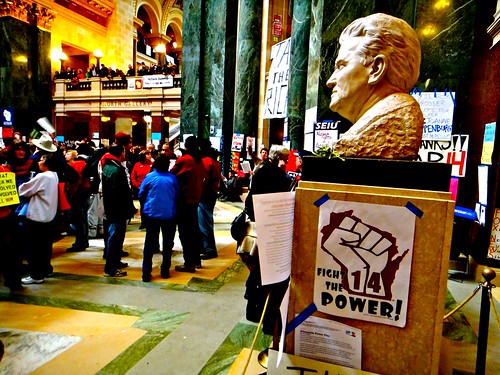
I originally blogged that here, with other photographs, including one showing how some protesters had used the back of the Veterans Memorial as a component of what they called their "Information Station."
And let me use this post to comment on something Scott Walker said at the end of his CPAC speech yesterday. What would he do about ISIS? "If I can take on 100,000 protesters, I can do the same across the globe." That was bad, obviously, and Walker has sent his spokeswoman to rephrase what was supposedly in The Head of Walker. (I'm saying "The Head of Walker" because I'm picturing a "Soviet-like" head of Walker some day, in the capitol, eye-to-eye with Bob La Follette, which would be the "more speech" alternative to iconoclasm.) The spokeswoman said:
Is that the kind of leadership he's proposing to use in the war on terror? It can't be. The relevant component of leadership that I'm seeing is something I associate with George W. Bush: silent acceptance of abuse from his critics. Walker said "If I can take on 100,000 protesters," but he didn't take them on. He let them carry on. That may have been wise under the circumstances, but it tells us close to nothing about what he would do with enemies who won't limit themselves to protesting and when he can't control the outcome through partisan domination of a legislature. Sheer cockiness won't do the trick � "If I can take on 100,000 protesters, I can do the same across the globe." And that was a cockiness beyond what we saw � and got tired of � in George Bush.
Here's a picture I took of the monumental head on February 25, 2011, a little over a week after the big protests had begun in and around the Wisconsin capitol:
I originally blogged that here, with other photographs, including one showing how some protesters had used the back of the Veterans Memorial as a component of what they called their "Information Station."
And let me use this post to comment on something Scott Walker said at the end of his CPAC speech yesterday. What would he do about ISIS? "If I can take on 100,000 protesters, I can do the same across the globe." That was bad, obviously, and Walker has sent his spokeswoman to rephrase what was supposedly in The Head of Walker. (I'm saying "The Head of Walker" because I'm picturing a "Soviet-like" head of Walker some day, in the capitol, eye-to-eye with Bob La Follette, which would be the "more speech" alternative to iconoclasm.) The spokeswoman said:
Governor Walker... was in no way comparing any American citizen to ISIS. What the governor was saying was when faced with adversity he chooses strength and leadership. Those are the qualities we need to fix the leadership void this White House has created.There's still a problem. How would the form of leadership demonstrated during the protests transfer to the war on terrorism? Scott Walker's approach to the protests was to let them play out � replete with loud chanting and drumming and lots of taped up signs in the capitol and huge marches outside � all the while knowing he had the votes in the legislature to pass the law that the protesters were protesting. He chose silent inaction, putting up with it, in a situation where he knew he'd win in the end, and, in fact, when the legislation finally passed, the protests ended. There was still the recall effort, and there was plenty more speech lambasting Walker, but Walker knew all along he had the upper hand, and instead of trying to counter the speech of the protesters (or even to get them cleared out of the capitol), he sat back and let them have what probably looked to most Wisconsinites like a big tantrum. He knew that the protesters knew that they could not cross the line from semi-organized protest to anything like violence or the threat of violence. The no-response response was therefore effective.
Is that the kind of leadership he's proposing to use in the war on terror? It can't be. The relevant component of leadership that I'm seeing is something I associate with George W. Bush: silent acceptance of abuse from his critics. Walker said "If I can take on 100,000 protesters," but he didn't take them on. He let them carry on. That may have been wise under the circumstances, but it tells us close to nothing about what he would do with enemies who won't limit themselves to protesting and when he can't control the outcome through partisan domination of a legislature. Sheer cockiness won't do the trick � "If I can take on 100,000 protesters, I can do the same across the globe." And that was a cockiness beyond what we saw � and got tired of � in George Bush.
ISIS endeavors to destroy the art of ancient Nineveh (AKA Mosul).
The efforts at destruction that you see at the beginning of this video are not as horrible as they look, for reasons that are explained half way through.
Watch out for the British expert who appears at 1:47. She thinks it's "pretty rotten for the people who actually live" in northern Iraq that so many of the original works of art have been transferred to Western museums � even as it's apparent that if those sculptures had been left in northern Iraq, they would now be sledgehammered to bits. Or does she � do we � think that if the artworks had been left in place, the history of Iraq would have played out on a different path, and the people who live there would have treasured and protected the world's artistic heritage? From the article at the link (to the British Channel 4 site):

And I can't look at that and not think about the statue of Saddam Hussein that our military tore down in Bagdhad in April 2003. And what of all those monumental statues of Vladimir Lenin that came in for destruction when the Soviet Union dissolved. Would you like to see them all removed?
I know there's at least one still standing, because the NYT, just a couple days ago, ran a story cooing over an aging American couple who are using Airbnb to live in various European cities and the slideshow features the man, dressed in shorts, like a child, and standing, like a child, knee-high to "this statue of Lenin in Lithuania." The hand of the smiling child-man reaches out to encircle the index finger of Soviet dictator. In another photo, the woman, in a short skirt, poses at the feet of a giant Stalin. This one too is "in Lithuania." We're told there's "a sculpture garden." Isn't that nice?
I need to do my own research to find out about "Grutas Park (unofficially known as Stalin's World...)... a sculpture garden of Soviet-era statues and an exposition of other Soviet ideological relics from the times of the Lithuanian SSR."
Watch out for the British expert who appears at 1:47. She thinks it's "pretty rotten for the people who actually live" in northern Iraq that so many of the original works of art have been transferred to Western museums � even as it's apparent that if those sculptures had been left in northern Iraq, they would now be sledgehammered to bits. Or does she � do we � think that if the artworks had been left in place, the history of Iraq would have played out on a different path, and the people who live there would have treasured and protected the world's artistic heritage? From the article at the link (to the British Channel 4 site):
The demolition squad of the Islamic State are following in the tradition of the Taliban who blew up the Buddhas at Bamyan, in Afghanistan, and the Malian jihadi group Ansar al Dine which destroyed mud tombs and ancient Islamic manuscripts in Timbuktu. They quote suras from the Koran that they say demand the destruction of idols and icons.Iconoclasm. If you're inclined to reach back into history, you will, perhaps, find it everywhere. From the Wikipedia article "Iconoclasm," here are "The Sons of Liberty pulling down the statue of George III of the United Kingdom on Bowling Green (New York City), 1776":
But iconoclasm isn't just a Salafi Islamic idea. In the 17th Century, puritans, under the rule of Oliver Cromwell, destroyed Catholic holy objects and art in Britain.
"We pulled down two mighty great angells, with wings, and divers other angells . . . and about a hundred chirubims and angells," wrote William Dowsing, Cromwell's chief wrecker, after leading his henchmen into Peterhouse college chapel in Cambridge in December 1643.

And I can't look at that and not think about the statue of Saddam Hussein that our military tore down in Bagdhad in April 2003. And what of all those monumental statues of Vladimir Lenin that came in for destruction when the Soviet Union dissolved. Would you like to see them all removed?
I know there's at least one still standing, because the NYT, just a couple days ago, ran a story cooing over an aging American couple who are using Airbnb to live in various European cities and the slideshow features the man, dressed in shorts, like a child, and standing, like a child, knee-high to "this statue of Lenin in Lithuania." The hand of the smiling child-man reaches out to encircle the index finger of Soviet dictator. In another photo, the woman, in a short skirt, poses at the feet of a giant Stalin. This one too is "in Lithuania." We're told there's "a sculpture garden." Isn't that nice?
I need to do my own research to find out about "Grutas Park (unofficially known as Stalin's World...)... a sculpture garden of Soviet-era statues and an exposition of other Soviet ideological relics from the times of the Lithuanian SSR."
Founded in 2001 by entrepreneur Viliumas Malinauskas, the park is located near Druskininkai, about 130 kilometres (81 mi) southwest of Vilnius, Lithuania.... Its establishment faced some fierce opposition, and its existence is still controversial.... The park also contains playgrounds, a mini-zoo and cafes, all containing relics of the Soviet era. On special occasions actors stage re-enactments of various Soviet-sponsored festivals.So there's an alternative to iconoclasm.
The word that got Keith Olbermann in trouble: "pitiful."
Keith Olbermann got suspended from his ESPN show for tweeting "Pitiful." He was responding to a tweet by a Penn State graduate who'd tweeted "We are!" (linking to an article about raising $13 million for charity). Olbermann proceeded to tweet "PSU students are pitiful because they�re PSU students � period."
"Pitiful" is a strange word. When we see it alone, as in Olbermann's tweet, we assume it conveys contempt. The 4th meaning in the OED is: "Evoking pitying contempt; very small, poor, or meagre; paltry; inadequate, insignificant; despicable, contemptible." $13 million is very small if the idea is to balance the harm that was done to Penn State's reputation in the recent scandal, and Olbermann has been a critic of the settlement.
"Pitiful" can mean "Full of or characterized by pity; compassionate, merciful, tender." You'd think that literal meaning would predominate in the absence of context, but it doesn't. "Pathetic" works the same way. We assume the sarcastic version: "Miserably inadequate; of such a low standard as to be ridiculous or contemptible." The older, more literal meaning � "Arousing sadness, compassion, or sympathy, esp. through vulnerability or sadness; pitiable" � is overshadowed to the point where you can't even use it without explaining yourself.
And you can't explain yourself on Twitter.
"Pitiful" is a strange word. When we see it alone, as in Olbermann's tweet, we assume it conveys contempt. The 4th meaning in the OED is: "Evoking pitying contempt; very small, poor, or meagre; paltry; inadequate, insignificant; despicable, contemptible." $13 million is very small if the idea is to balance the harm that was done to Penn State's reputation in the recent scandal, and Olbermann has been a critic of the settlement.
"Pitiful" can mean "Full of or characterized by pity; compassionate, merciful, tender." You'd think that literal meaning would predominate in the absence of context, but it doesn't. "Pathetic" works the same way. We assume the sarcastic version: "Miserably inadequate; of such a low standard as to be ridiculous or contemptible." The older, more literal meaning � "Arousing sadness, compassion, or sympathy, esp. through vulnerability or sadness; pitiable" � is overshadowed to the point where you can't even use it without explaining yourself.
And you can't explain yourself on Twitter.
"... Coming Home was produced by Jane Fonda, who at that time had made films with Ho Chi Minh and was virulently anti-American. At the Academy Awards, she wouldn't look at me..."
"... because I had already been labeled a right-wing fascist," says the movie director Michael Cimino in a new interview. His "Deer Hunter" was up against "Coming Home" for the awards in 1971.
We were in the same elevator together. I wanted to say congratulations, but she turned away. From what I know about the original script, ["Coming Home"] was honest, but I think because of her political stance at the time, she managed to turn it into American guilt. She's the only one who had the power � she was the producer. The end of the movie is the American officer, Bruce Dern, who out of unspeakable guilt walks into the Pacific Ocean to drown himself. That's not what the original script was. That character is so filled with rage that he strides the hillsides of Laurel Canyon onto the 101, as I recall, and he's got a machine gun with him. He walks to the center of the freeway with oncoming traffic in both directions, and he's just howling, just firing in a circle. Cars are blowing up all over the place. That was the real ending. You don't have moviemaking to prove a point about your political conviction in American Sniper.About "American Sniper," he says: "Though it was characterized [as such], Sniper's not a political movie. It's not about the rightness or wrongness of the war. It deals with the impact of trauma on people who go to war and people who stay behind."
Thursday, February 26, 2015
"An Italian surgeon is hoping to perform the world�s first human head transplant..."
"... claiming he could have recipients of the radical surgery thinking their own thoughts and speaking with their own voice."
Oh, I know what that looks like. The question is: How much are they paying you?
Oh, I know what that looks like. The question is: How much are they paying you?
Kids play "Kashmir."
("The Louisville Leopard Percussionists... are a performing ensemble of approximately 55 student musicians, ages 7-12, living in and around Louisville, Kentucky.")
The return of the "Shame!" chant to the Wisconsin state senate.
"#RightToWork passes 17-14, gallery shouting "Shame." #wipolitics" � video at the link.
Here's the "Shame!" chant of February 25, 2011.
Here's the "Shame!" chant of February 25, 2011.
The time the marijuana-growing, suicide-committing, cherry-factory-owner turned the local bees red.
"When the sun is a bit down, they glow red in the evenings...They were slightly fluorescent. And it was beautiful," said one bee-keeper in the vicinity of the Dell's marachino-cherry factory in Red Hook, Brooklyn, back in 2010.
(I linked to The Daily Mail's story in a short post yesterday.)
[The owner of the factory Arthur] Mondella did not return phone calls seeking comment....That was 2010. Last Tuesday, "Mr. Mondella, 57, shot and killed himself in his office bathroom just as city investigators were discovering that a marijuana farm lay beneath the factory." That link goes to the NYT, which took me to the Red Bees of Red Hook story with the line "The most controversy the factory had attracted before this came several years ago, when local bees began turning red after feasting on the cherry liquid."
�Bees will forage from any sweet liquid in their flight path for up to three miles,� [said Andrew Cot�, the leader of the New York City Beekeepers Association]. While he has not yet visited the factory, he said that the bees might be drinking from its runoff.... Could the tastiest nectar, even close by the hives, compete with the charms of a liquid so abundant, so vibrant and so cloyingly sweet? Perhaps the conundrum raises another disturbing question: If the bees cannot resist those three qualities, what hope do the rest of us have?
A story of the perils of urban farming, this is also a story of the careful two-step of gentrification....
(I linked to The Daily Mail's story in a short post yesterday.)
Subscribe to:
Comments (Atom)